
There’s something uniquely satisfying about walking into a room that does exactly what you need it to do.
A master bath-closet combo is one of those rare spaces where function and beauty can genuinely coexist — but only if you plan it thoughtfully.
Whether you’re working with a sprawling ensuite or a modest bedroom corner, the right layout can turn your morning routine from chaotic to completely luxurious.
And no, you don’t need a renovation budget the size of a small country.
Some of the most beautiful bath-closet combos I’ve seen were pulled together with clever IKEA hacks, a few well-chosen splurges, and a lot of intentional styling.
Let’s talk about what actually works.
1. The Open Concept Wardrobe Walk-Through
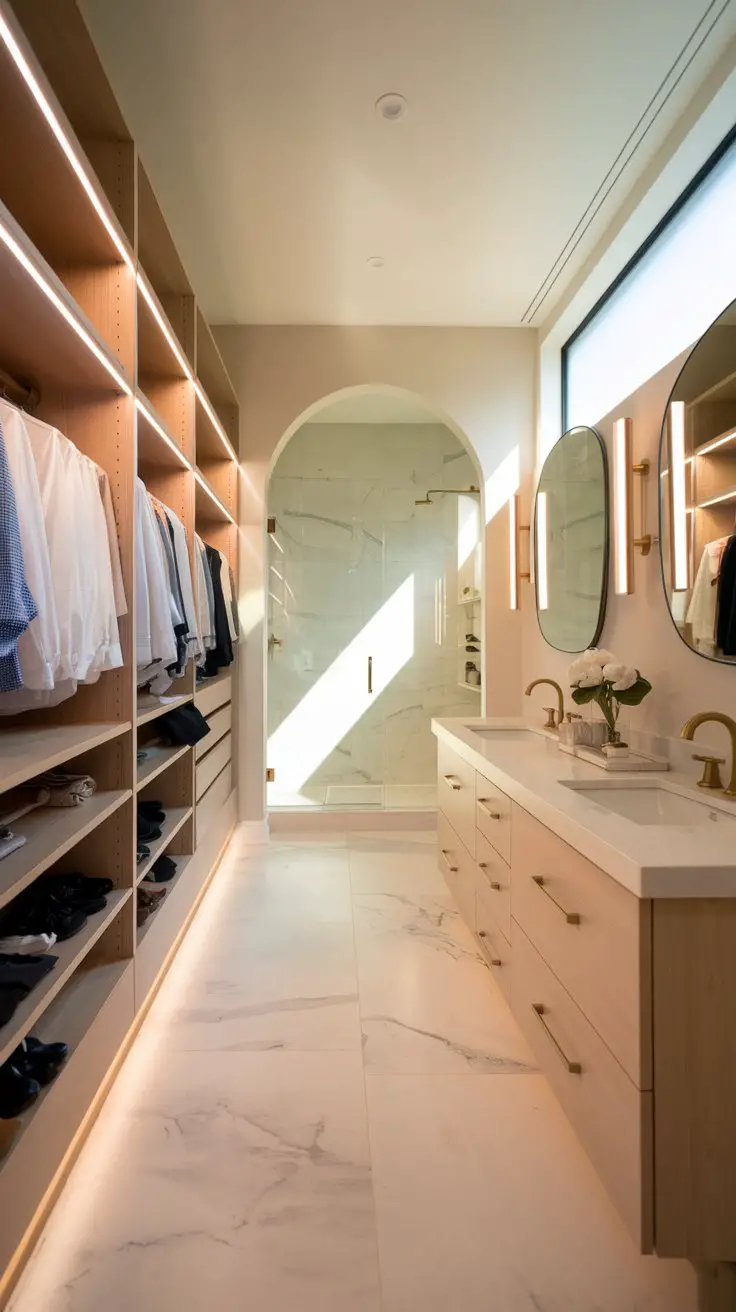
How to Recreate This Look
The open walk-through concept works by eliminating the visual boundary between your closet and bathroom, creating a single, intentional suite rather than two cramped rooms awkwardly sharing a wall.
Shopping List:
- Open shelving system (IKEA PAX customized with wood veneer overlays — ~$400–$900 depending on configuration)
- LED shelf lighting strips (Amazon or Home Depot, ~$25–$60 per strip)
- Brushed gold or matte black hardware for any cabinet doors (~$8–$20 per pull)
- Matching baskets or bins for folded items (Target’s Threshold line, ~$12–$30 each)
- Neutral linen curtain panel as a soft room divider if you want occasional privacy (~$40–$80)
Step-by-Step Styling Instructions:
- Remove any existing door between the closet and bathroom to open sightlines
- Paint both spaces the same wall color — this single step unifies them instantly
- Install your shelving system and organize clothing by category, then by color within each category
- Add LED strip lighting under shelves for both practicality and that boutique hotel glow
- Bring one decorative element from the bathroom into the closet (a small ceramic tray, a candle, a plant) to visually connect the two spaces
Budget Breakdown:
- Under $100: Paint both rooms the same color, add a linen curtain panel in the doorway, remove the door entirely, and reorganize existing storage with matching bins
- $100–$500: IKEA PAX system, LED lighting, matching hardware throughout
- $500+: Custom built-in cabinetry with integrated lighting, professional paint, coordinating tile or flooring that flows between both rooms
Space Requirements: Works best when the closet is at least 5 feet wide and positioned adjacent to (not across from) the primary bathroom.
Difficulty Level: Intermediate — removing a door is simple, but coordinating a cohesive aesthetic across two rooms takes a thoughtful eye.
Lifestyle Consideration: If you share this space with a partner whose schedule differs from yours, the open concept means bathroom light and noise travels freely. A dimmer switch is non-negotiable here.
Common Mistake to Avoid: Don’t mix too many wood tones. Pick one — warm oak, cool walnut, or painted white — and commit to it across both rooms.
2. The Boutique Dressing Room With Vanity Integration
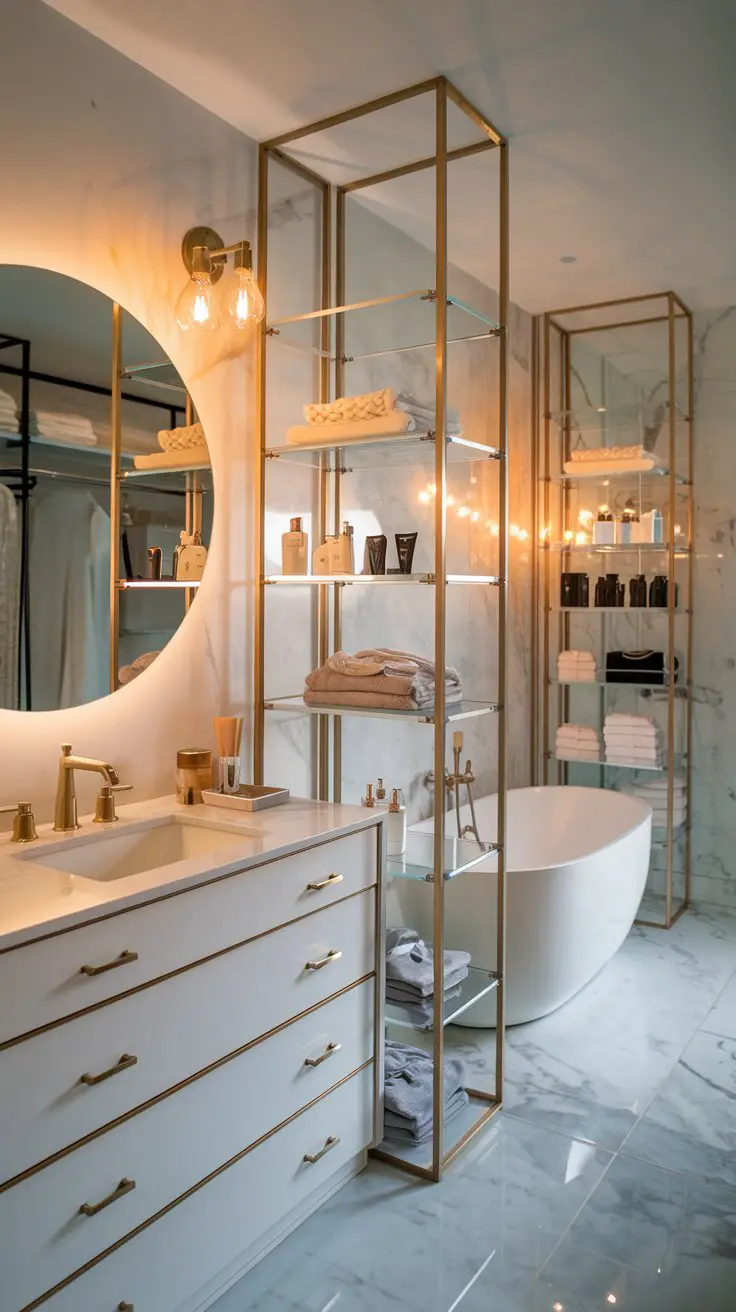
How to Recreate This Look
A dedicated makeup vanity inside your closet keeps your bathroom counter clear (finally) and creates a genuinely enjoyable getting-ready ritual.
Shopping List:
- Vanity desk or floating wall shelf as vanity surface (IKEA ALEX desk ~$250, or custom floating shelf ~$80–$200 DIY)
- Backlit round mirror (Amazon, ~$60–$200)
- Hollywood-style bulb mirror for a more dramatic look (~$100–$400)
- Small organizer trays for makeup and skincare (Muji acrylic sets, ~$15–$40)
- Upholstered stool (~$50–$200)
- Power strip with USB ports installed inside cabinetry (~$20–$35)
Step-by-Step Styling Instructions:
- Identify a wall in your closet that’s at least 30 inches wide and can accommodate a desk or floating shelf at 28–30 inches height
- Mount your chosen mirror centered above the surface — lighting is everything here
- Install a hidden power strip inside or behind a cabinet for charging devices and powering lighting
- Use small trays to organize products by category: daily skincare, weekly treatments, makeup by type
- Add one personal touch — a small floral arrangement, a framed print, or a favorite perfume displayed like art
Budget Breakdown:
- Under $100: Repurpose a narrow console table as a vanity, add a frameless mirror and a plug-in ring light
- $100–$500: IKEA ALEX desk, backlit mirror, acrylic organizers, upholstered stool
- $500+: Custom built-in floating vanity with quartz surface, Hollywood mirror, integrated charging
Difficulty Level: Beginner to intermediate — the setup is straightforward; the styling takes an afternoon.
Seasonal Adaptability: Swap your displayed perfumes and candles seasonally for an easy refresh — floral and citrus in spring/summer, warm amber and oud in fall/winter.
3. The His-and-Hers Split System
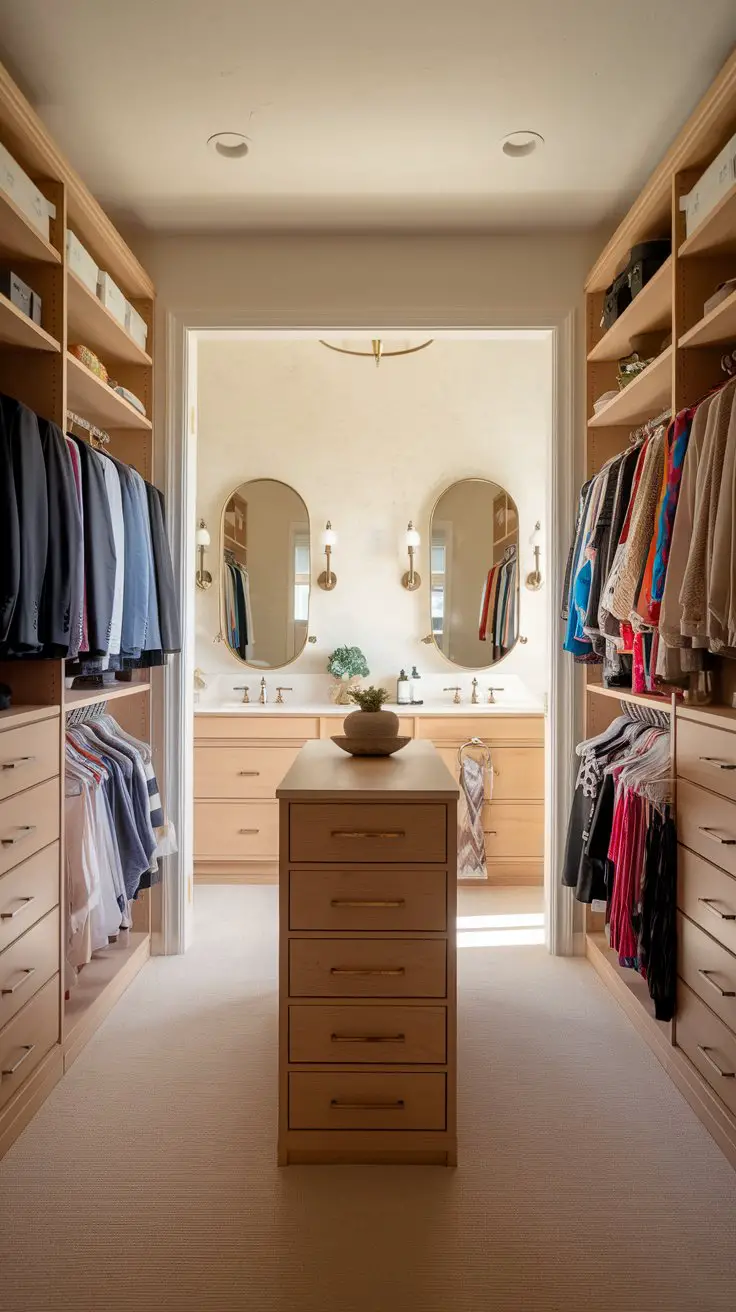
How to Recreate This Look
The eternal challenge of a shared closet is usually less about space and more about boundaries. A clearly defined split system solves this with zero arguments required. (Mostly. BTW, I make no promises about the drawer situation.)
Shopping List:
- Two matching but configurable shelving units (IKEA PAX, The Container Store Elfa — ~$300–$800 each)
- Center island or rolling cart for shared accessories or folded items (~$150–$600)
- Label maker or acrylic labels (~$15–$40)
- Matching velvet hangers for a unified, polished look — even if the contents differ (~$15–$25 per pack of 50)
- Individual drawer organizers in each person’s preferred configuration (~$10–$30 each)
Step-by-Step Styling Instructions:
- Measure your closet and divide the space — not necessarily 50/50, but proportionally based on each person’s wardrobe
- Install matching shelving systems on each side for visual symmetry even as contents differ
- Use identical hangers throughout — this alone makes a dramatic difference in how organized and intentional the space looks
- Add a center island or even a simple storage ottoman as a neutral shared zone
- Let each person style their own side according to their preferences — the matching framework does the visual work of cohesion
Difficulty Level: Intermediate — requires precise measuring and potentially some negotiation. The latter is harder than the former, in my experience.
Common Mistake: Installing two completely different shelving systems. The visual clash will make the whole closet feel chaotic. Matching frameworks, individual configurations.
4. The Compact Ensuite With Built-In Niche Storage
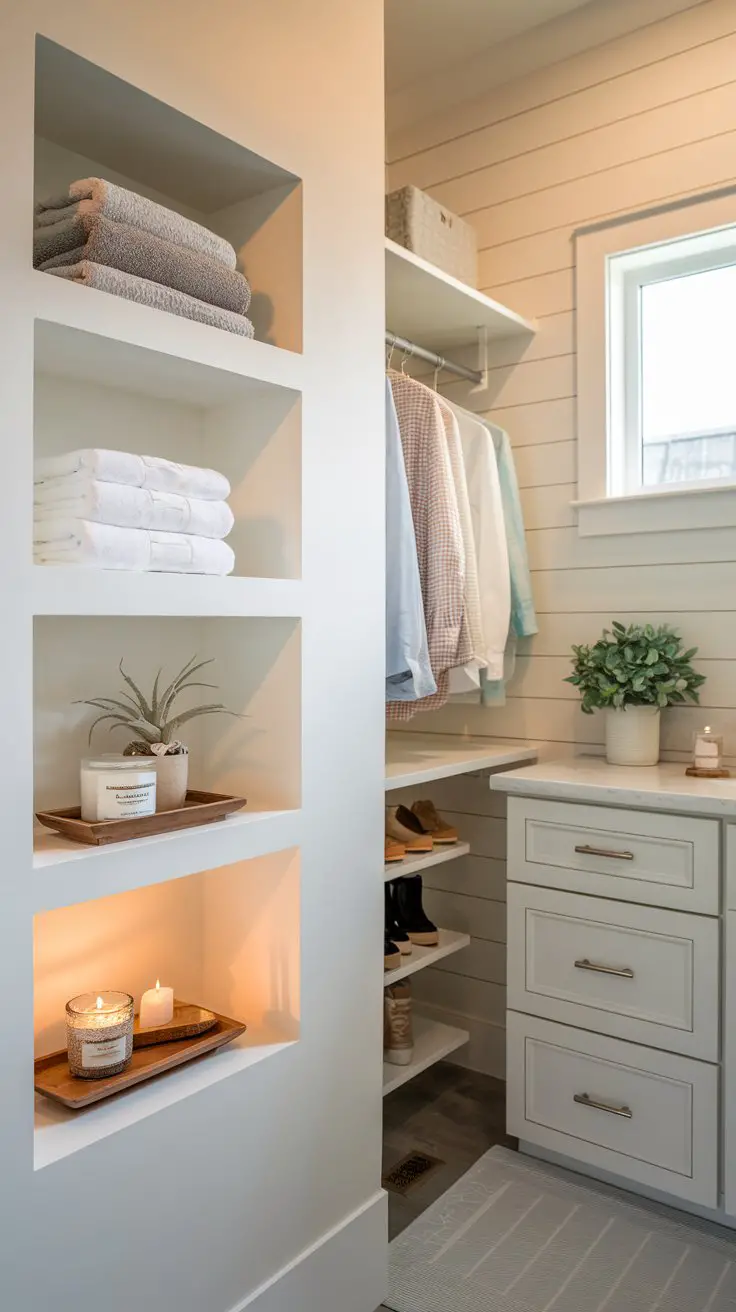
How to Recreate This Look
Small spaces don’t have to feel small. Built-in niche storage between a bathroom and closet uses dead wall space brilliantly — and it looks genuinely custom without requiring a full renovation.
Shopping List:
- Pre-made wall niche inserts (available at tile stores and Home Depot, ~$30–$80 each)
- Floating shelves as an alternative if recessing into the wall isn’t possible (~$20–$60 each)
- Matching baskets or woven bins for closed storage within niches (~$15–$30 each)
- Small air plants or succulents (~$5–$20 each — virtually indestructible, perfect for humid bathroom-adjacent spaces)
- Wooden tray for bath accessories (~$15–$40)
Budget Breakdown:
- Under $100: Add floating shelves between spaces, use matching baskets, add simple styling elements
- $100–$500: Install pre-made niche inserts with tile surround, add a small compact closet system
- $500+: Recessed built-in niches with custom tilework, full built-in closet system with integrated lighting
Space Requirements: Works in rooms as small as a 7×7 bedroom closet adjacent to a 5×8 bathroom.
Difficulty Level: Beginner (floating shelves) to Advanced (recessed niches requiring drywall work).
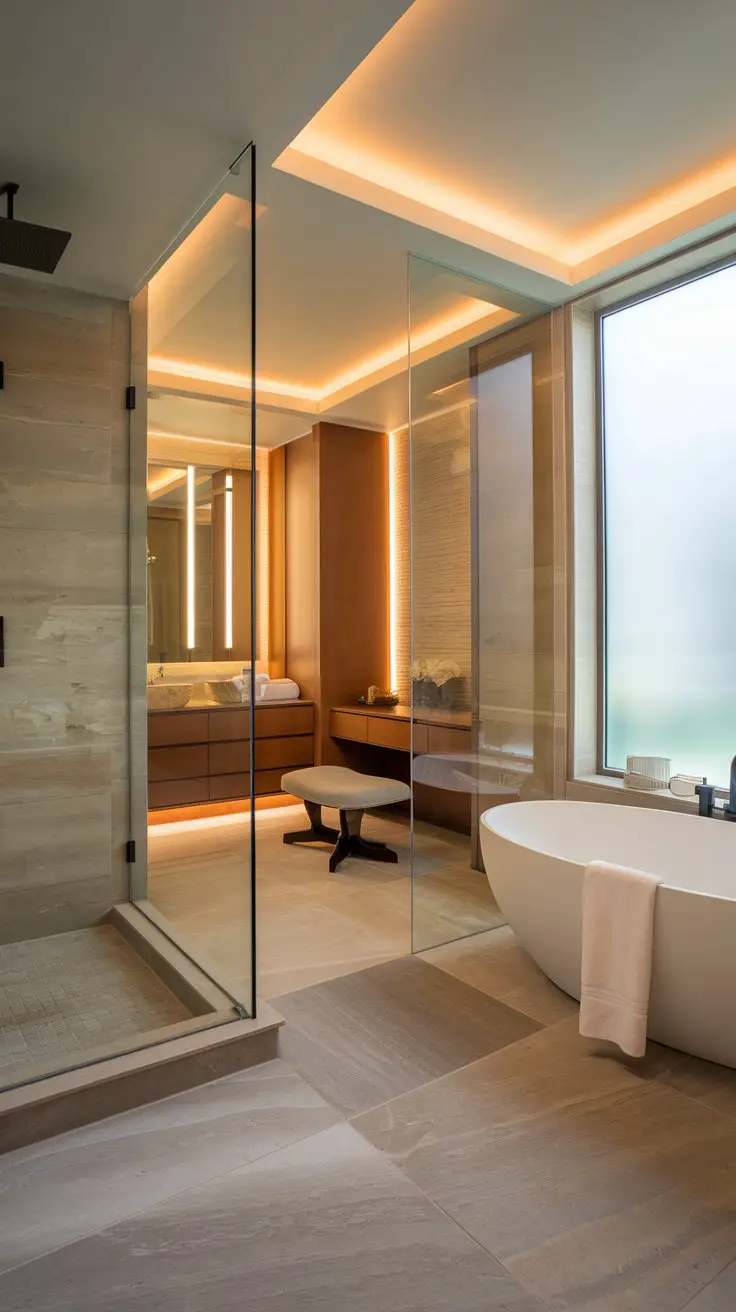
5. The Spa-Inspired Wet Room Pass-Through
How to Recreate This Look
This is the one that feels most like a hotel spa — and it’s more achievable than it looks, particularly if you’re open to using cohesive materials and removing the visual barriers between your bathroom and dressing area.
Shopping List:
- Continuous flooring material — running the same tile or engineered hardwood from dressing area into bathroom (where appropriate moisture-rated materials allow) creates instant cohesion
- Upholstered bench for the closet/dressing area (~$80–$400)
- Matching towel hooks or bars in the same finish as closet hardware (~$15–$60)
- Large format tile for visual spaciousness (24×24 or larger, ~$2–$8 per square foot)
- Eucalyptus or bamboo plant for that authentic spa atmosphere (~$15–$40)
- Waffle-weave or linen towels in a neutral palette (~$20–$60 per set)
Difficulty Level: Advanced if you’re renovating tile and archways. Beginner if you’re styling an existing layout with cohesive accessories.
Lifestyle Note: This look rewards minimalism. Clutter in this aesthetic is especially visible — invest in closed storage for anything that doesn’t belong on display.
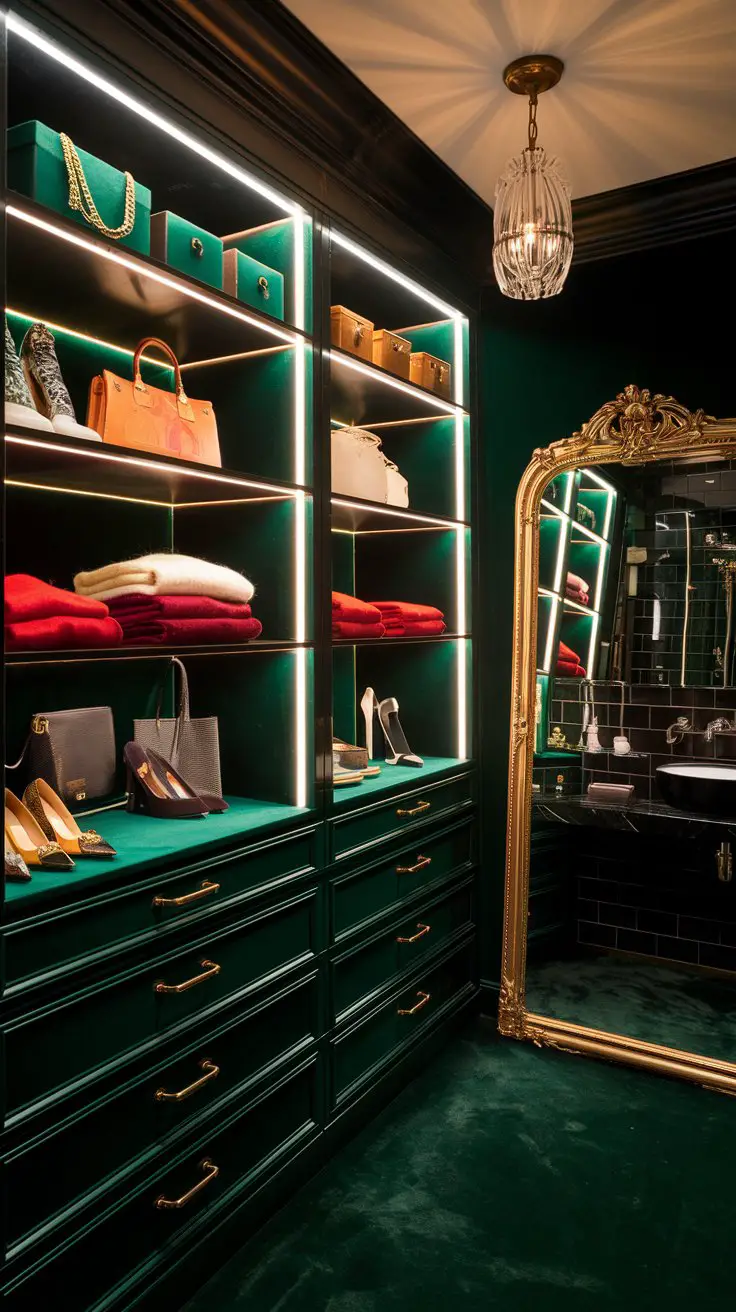
6. The Maximalist Dressing Room Gallery
How to Recreate This Look
Who said closets have to be neutral? The maximalist dressing room approach treats your clothing as the art collection it absolutely is.
Shopping List:
- Deep paint color for closet walls (Farrow & Ball, Benjamin Moore, or even affordable alternatives like BEHR — ~$40–$80 per gallon)
- Antique-style or ornate floor mirror (~$80–$400)
- Velvet-lined drawer dividers (~$20–$60 per drawer)
- Small chandelier or decorative pendant light (~$60–$400)
- Display risers or acrylic stands for shoe and bag display (~$15–$40)
Budget Breakdown:
- Under $100: Paint the closet a bold deep color, add a secondhand ornate mirror, style shelves with intention
- $100–$500: New shelving, velvet drawer liners, small chandelier, matching display risers
- $500+: Full built-in with custom paint, statement lighting, upholstered island
Common Mistake: Going bold on the walls but leaving the rest of the styling generic. In a maximalist space, every detail needs to feel intentional. Commit fully or pull back.
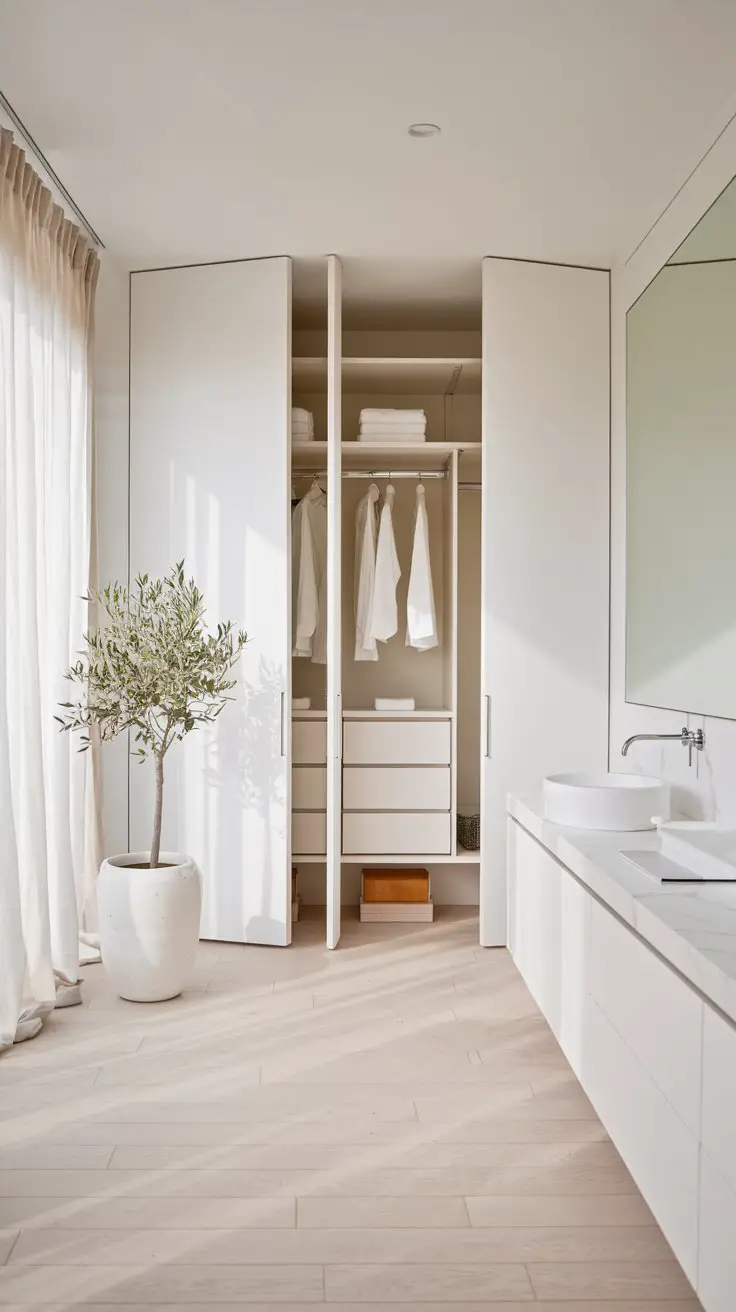
7. The Minimalist White Box
How to Recreate This Look
The all-white approach sounds risky (and yes, the coffee spill anxiety is real), but a thoughtfully executed white-on-white space is one of the most enduringly beautiful options for a combined bath-closet. The secret is layering textures, not colors.
Shopping List:
- Flat-front cabinet doors for existing shelving units to hide clothing from view (~$30–$100 per door depending on size)
- Push-to-open hardware or minimal bar pulls in brushed nickel or matte white
- White or natural linen storage bins for open shelving areas
- Olive tree or white-leafed plant in a white ceramic planter (~$40–$120)
- Matching white textured towels (waffle weave, ribbed cotton — ~$15–$40 per set)
Difficulty Level: Beginner in terms of styling. The challenge is maintenance — white everything requires a commitment to tidiness that not everyone realistically has. (No judgment. I lasted three weeks before a mascara incident.)
Seasonal Adaptability: Swap textiles seasonally — linen and lighter textures in summer, chunky knit throws and thicker towels in winter — while keeping the white palette constant.
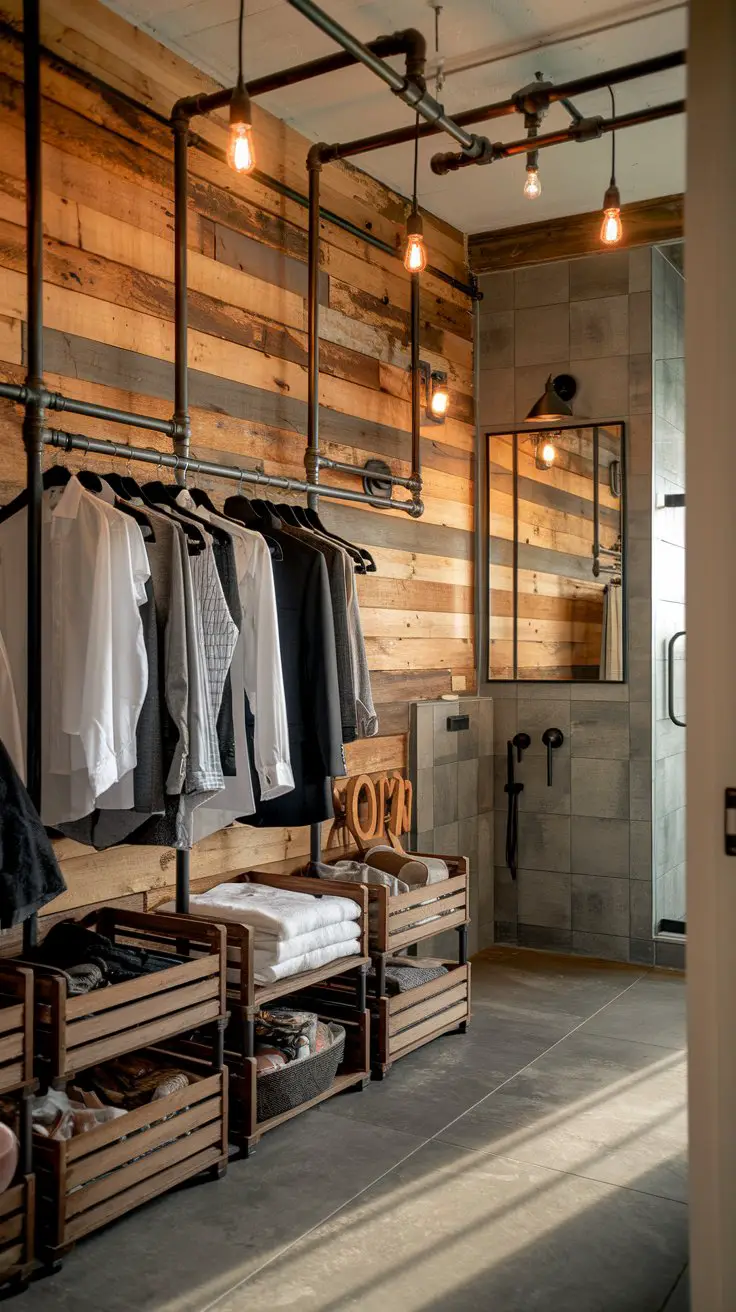
8. The Industrial Pipe-and-Wood Open System
How to Recreate This Look
This is one of my absolute favorite looks for renters and budget decorators because it’s completely removable, endlessly customizable, and honestly? It looks like you spent a fortune when you spent maybe $150.
Shopping List:
- Black iron pipe clothing rod kit (available on Amazon or at plumbing supply stores, ~$40–$120 for a full run)
- Reclaimed wood plank wallboards (peel-and-stick options available for renters, ~$30–$80 per pack)
- Edison bulb plug-in pendant lights (~$20–$50 each)
- Wooden crates or wire baskets for folded storage (~$10–$25 each)
- Matching black matte hooks for bags and accessories (~$8–$20 per set)
Budget Breakdown:
- Under $100: Single pipe rod, a few Edison plug-in lights, wooden crates from a craft store
- $100–$500: Full pipe shelving system, peel-and-stick wood wall, coordinating storage baskets
- $500+: Custom welded pipe system, real reclaimed wood wall treatment, custom lighting
Rental-Friendly Note: Mount pipe rods into studs and patch holes on departure. Peel-and-stick wood panels come off cleanly. This entire look is reversible.
9. The Japandi Calm Corner
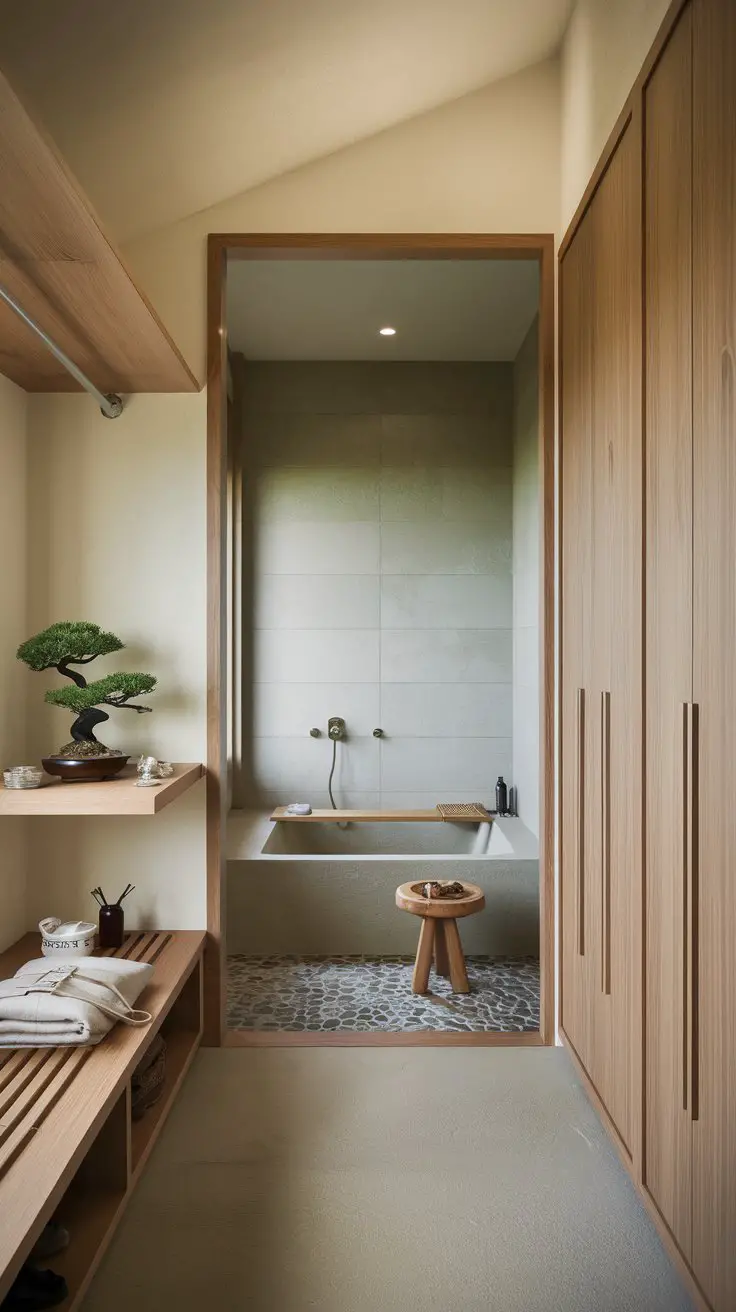
How to Recreate This Look
Japandi (Japanese + Scandinavian) design has exploded in popularity for good reason — it’s the aesthetic equivalent of a deep breath. In a bath-closet combo, it creates a morning routine that genuinely sets a calm tone for the day.
Shopping List:
- Bamboo or light ash wood cabinetry (IKEA KUNGSBACKA fronts in ash or bamboo alternatives, ~$20–$60 per door)
- Low wooden bench (~$60–$200)
- Bonsai tree or small sculptural plant (~$20–$80)
- Linen robe in natural or dusty sage (~$40–$120)
- Stone or pebble bath mat (~$30–$80)
- Minimal woven basket for laundry or storage (~$20–$60)
Difficulty Level: Beginner. Japandi is primarily an editing exercise — you’re removing things and choosing very intentionally, not adding complexity.
Common Mistake: Adding too many items. In Japandi, every object should earn its place. When in doubt, take one more thing away.
10. The Boutique Hotel Wardrobe With Ensuite Drama
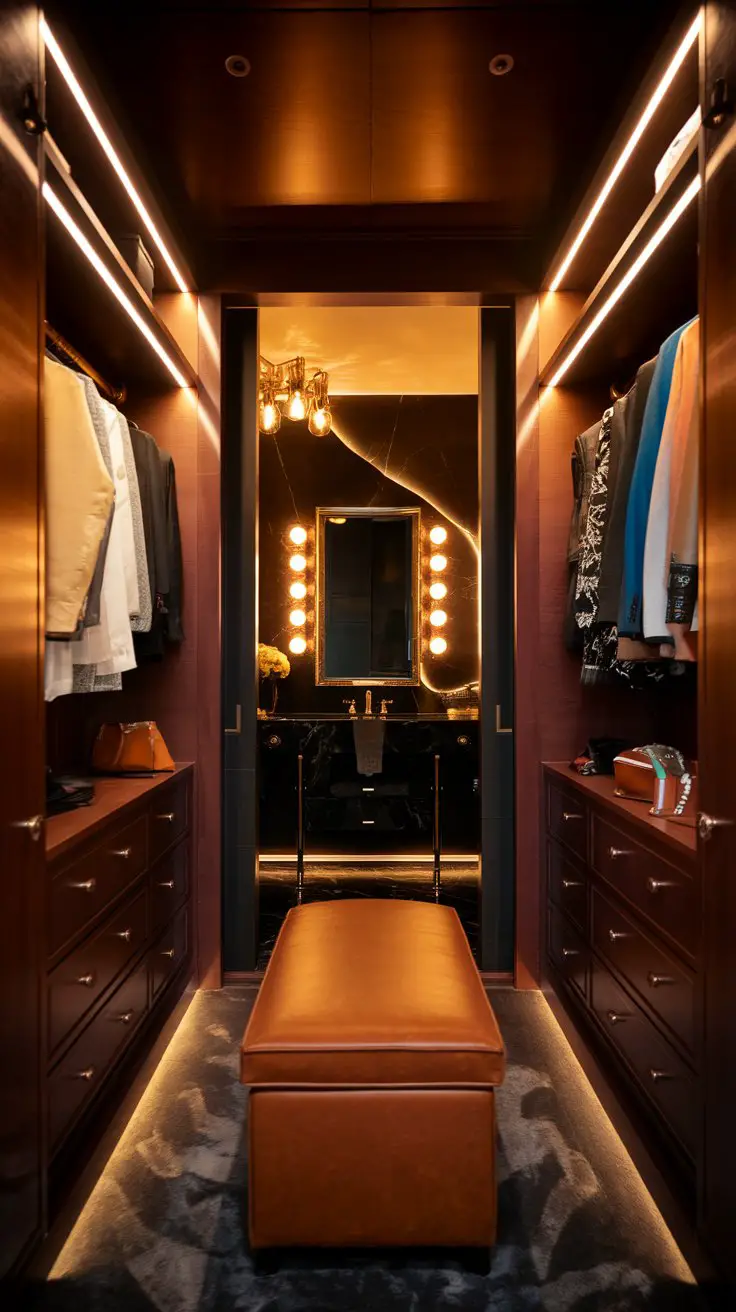
How to Recreate This Look
The boutique hotel wardrobe look is about making the everyday feel special — your clothes aren’t just stored here, they’re presented here. It’s a mindset shift as much as a design choice. 🙂
Shopping List:
- Deep wood-toned cabinetry or contact paper to transform existing units (~$40–$80 for contact paper, ~$400–$1,200 for new cabinetry)
- Recessed LED puck lights inside cabinets (~$15–$40 per light)
- Slim upholstered bench in leather or faux leather (~$100–$400)
- Matching wooden or velvet hangers throughout — absolutely no wire hangers in this look (~$20–$40 per pack)
- Luggage rack or valet stand for a genuinely hotel-accurate touch (~$40–$120)
- Small decorative tray for watches, jewelry, pocket items — styled like a room service tray (~$20–$60)
Budget Breakdown:
- Under $100: Contact paper on cabinetry, velvet hangers, a luggage rack, one recessed puck light
- $100–$500: New cabinet doors in dark tone, integrated lighting, upholstered bench, coordinating accessories
- $500+: Full custom dark wood cabinetry, built-in lighting, leather bench, custom bathroom updates with matching hardware
Difficulty Level: Beginner to intermediate. The investment is mostly in the styling details, not the structure.
Seasonal Adaptability: Rotate seasonal clothing into accessible sections and store off-season pieces in labeled bins on the highest or lowest shelves — exactly what a hotel concierge would do with your seasonal luggage.
Making It All Work: Your Space, Your Rules
At the end of the day — and truly, I mean this — the best master bath-closet combo is the one that makes your specific morning feel less chaotic and more enjoyable.
Whether that’s a moody Japandi sanctuary, an industrial pipe-and-wood system you built in an afternoon, or a full boutique hotel wardrobe with lighting that makes your jewelry sparkle, the goal is the same: a space that works hard and feels genuinely beautiful to you.
Don’t get caught up chasing a look that doesn’t match your actual life. A white minimalist closet is stunning until you have two kids and a golden retriever.
An open concept looks editorial until you realize you get dressed at 5am and your partner sleeps until 7. Design for your real life first, your dream aesthetic second. Usually, they can meet somewhere wonderful in the middle.
The space you’re standing in every single morning sets the tone for everything that follows. A little intention here — even on a modest budget — pays off in ways that genuinely matter. You deserve a space that feels like yours. Go make it. ❤

Greetings, I’m Alex – an expert in the art of naming teams, groups or brands, and businesses. With years of experience as a consultant for some of the most recognized companies out there, I want to pass on my knowledge and share tips that will help you craft an unforgettable name for your project through TeamGroupNames.Com!