
There’s something about opening a closet door in the morning that tells you everything about how your day is going to feel.
If you’re greeted by a cascading avalanche of forgotten gym shoes and sweaters you haven’t seen since 2019, that’s one kind of morning.
If you open to a space that’s calm, organized, and—dare I say it—a little beautiful? That’s a completely different relationship with your home.
The good news is that a walk-in closet transformation doesn’t require a contractor, a luxury budget, or even a free weekend.
Some of the most satisfying closet makeovers happen incrementally, one clever idea at a time.
Whether you’re working with a generous master closet or a “technically walk-in if you hold your breath” kind of space, there are real, affordable solutions that make a visible difference.
Let’s talk about what actually works.
1. Install a Double Hanging Rod System
How to Recreate This Look
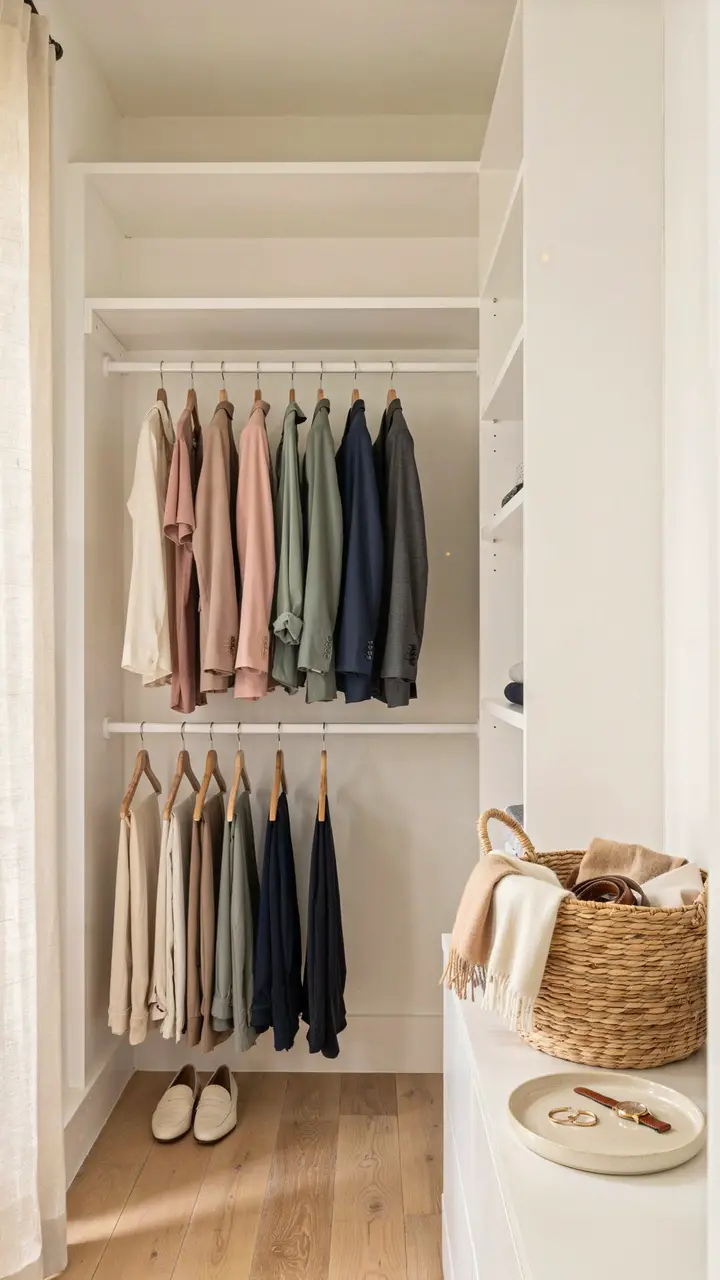
The single most effective thing you can do in a walk-in closet is double your hanging space—literally. Most closets come with one high rod, which wastes all the vertical space below it. A double rod system takes that same wall and gives you two full hanging zones.
Shopping list:
- Adjustable double hanging rod kit (Chrome or matte black): $25–$60 at Target, IKEA, or Amazon
- Slim velvet hangers (50-pack): $12–$18
- Woven basket for accessories: $15–$40 depending on size
- Optional wall anchors if drilling into drywall: ~$5
Step-by-step:
- Measure your wall from floor to ceiling and mark the bracket positions at stud locations
- Install the top rod first at approximately 66–72 inches from the floor
- Hang the lower rod so it falls around 36–42 inches from the floor, leaving clearance for your shortest items
- Sort clothing by length: long dresses and coats on one wall, and short shirts plus folded trousers on the double-rod wall
- Switch to uniform velvet hangers immediately—this one change makes a closet look 40% more organized with zero effort
Budget breakdown:
- Budget-friendly (under $100): Rod kit + velvet hangers + one basket = $55–$80 total
- Mid-range ($100–$500): Add custom brackets, matching storage bins, and a simple shoe shelf = $150–$250
- Investment-worthy ($500+): Built-in double-hang section from IKEA PAX or California Closets modular line
Space requirements: Works in any closet at least 24 inches deep and 4 feet wide. Narrower than that and the second rod becomes awkward to use.
Difficulty level: Beginner. If you can hold a drill and read a stud finder, you’ve got this in under an hour.
Lifestyle note: Velvet hangers are genuinely terrible with wet clothes—hang those elsewhere to dry. With kids, keep their rod at a lower height so they can reach independently (and can’t claim they “can’t find” anything).
Seasonal swap: In spring, shift winter coats to a garment bag on the top rod and free up the lower zone for lightweight layering pieces.
Common mistake: Cramming too many items onto each rod. Leave 20% breathing room—clothes you can actually see are clothes you’ll actually wear.
2. Add Open Shelving for Folded Items and Display
How to Recreate This Look
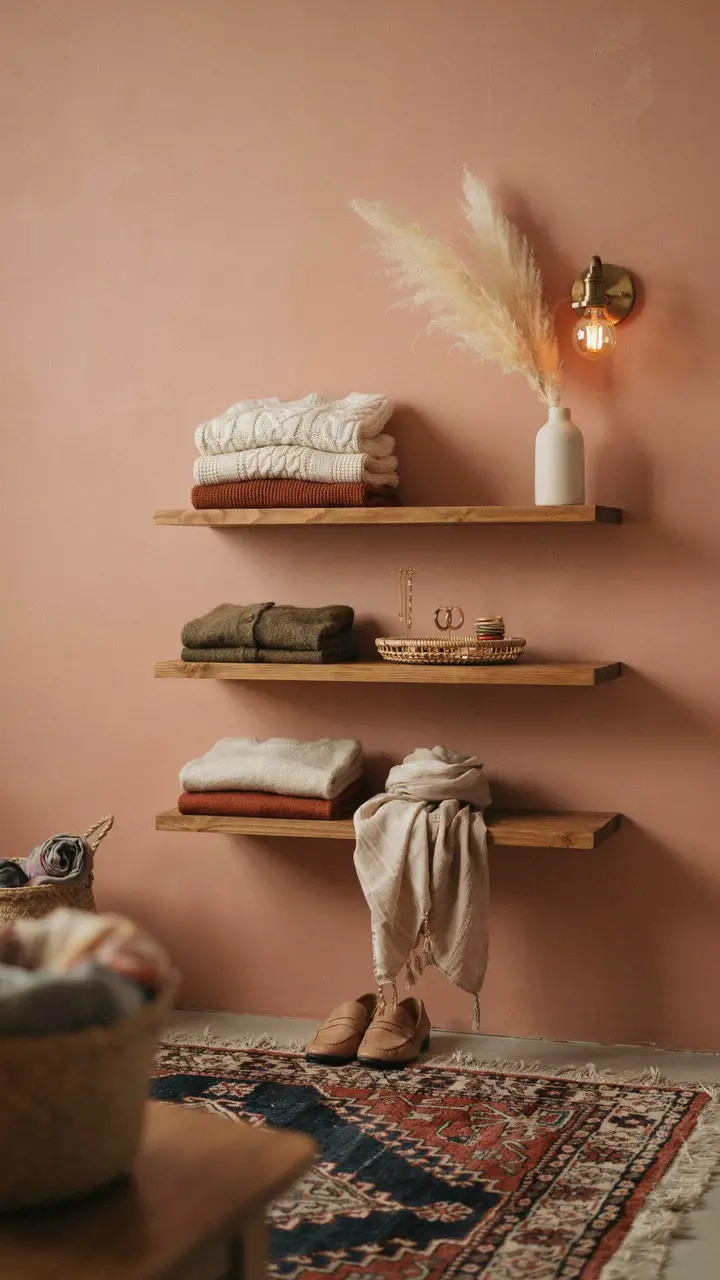
Open shelving is polarizing—some people love the visual accessibility, others find it anxiety-inducing because everything shows. Here’s the honest truth: open shelves work beautifully when you commit to keeping only folded items or display-worthy objects on them. Shove random clutter up there and they’ll make your closet look worse, not better.
Shopping list:
- Floating wood shelves (IKEA LACK or solid pine boards): $8–$35 per shelf
- Heavy-duty shelf brackets (for 12–14 inch depth): $10–$20 per pair
- Woven basket or dish for small accessories: $12–$25
- Optional: thin-profile LED strip lighting for underside of shelves: $20–$35
Step-by-step:
- Mark shelf positions at 12-inch intervals for maximum versatility
- Ensure brackets hit wall studs—floating shelves holding stacked sweaters carry real weight
- Paint your accent wall first if you’re doing a bold color, let it cure 48 hours before installing
- Style shelves by color-grouping folded items—it looks intentional and makes things easy to find
- Add one small decorative object per shelf (not more) to keep it feeling curated, not cluttered
Budget breakdown:
- Under $100: Two IKEA LACK shelves + brackets + existing baskets you already own
- $100–$500: Solid wood shelves cut to length + professional mounting + LED strip lighting
- $500+: Built-in shelving with integrated lighting and trim work
Space requirements: Ideal for walls at least 3 feet wide. Keep shelves no deeper than 14 inches in a walk-in to avoid eating into movement space.
Difficulty level: Beginner to intermediate. Finding studs in a closet can occasionally be tricky; a stud finder ($15 at any hardware store) is non-negotiable here. Skipping this step is how shelves end up on the floor at 2am. Don’t ask me how I know.
Common mistake: Overfilling every shelf. Less is genuinely more—if your eye doesn’t have a resting place, the whole shelf reads as chaos.
3. Use Clear Shoe Storage Boxes
How to Recreate This Look
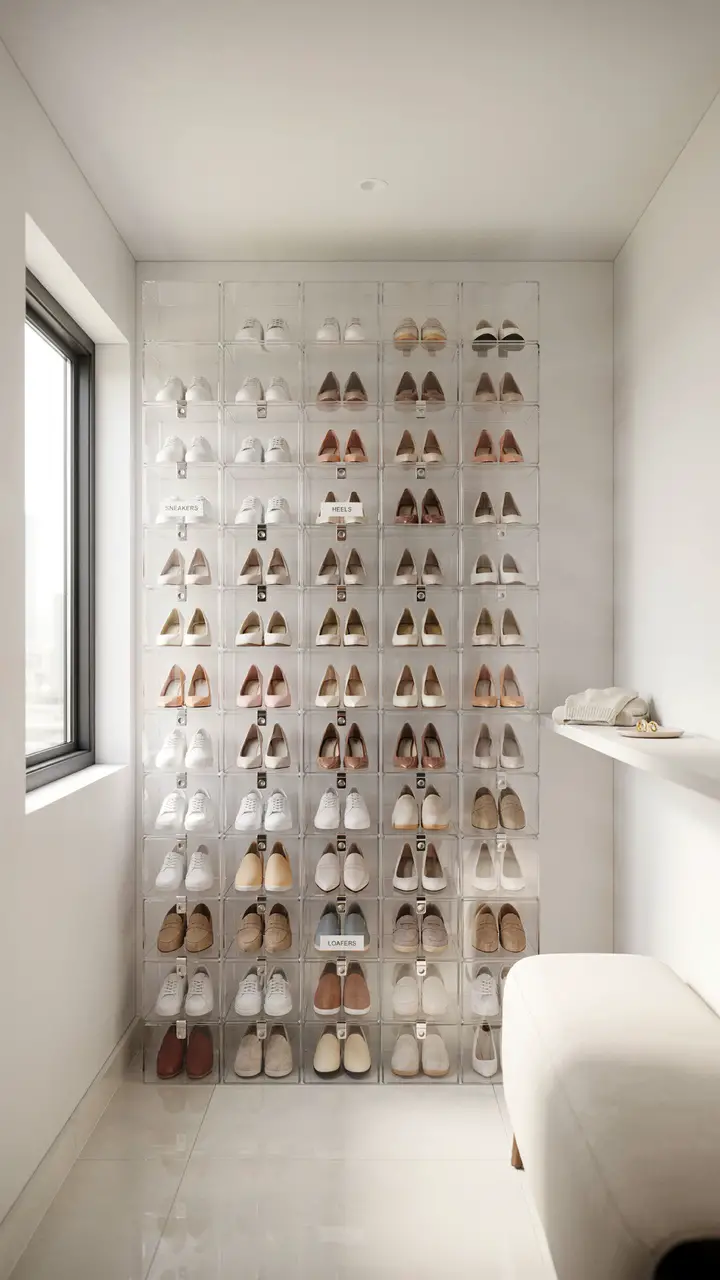
If you’ve ever spent eight minutes searching for the left shoe of a pair you know you own, clear shoe boxes will genuinely change your life. Not metaphorically. Actually change your daily routine.
Shopping list:
- Clear stackable shoe boxes (Ikea SKOBOX, Amazon basics, or The Container Store version): $3–$8 per box
- Label holders or a label maker: $10–$20 one-time investment
- Optional: a simple shoe rack as a base if stacking higher than 4 boxes: $20–$40
Step-by-step:
- Sort shoes into categories: everyday, heeled, athletic, seasonal
- Clean each pair before boxing—storing dirty shoes just traps the problem
- Label each box on the front with the shoe type (not the color—you’ll see that through the box)
- Stack boxes by frequency of use, keeping most-worn at eye level or below
- Store off-season shoes in opaque boxes to distinguish them at a glance
Budget breakdown:
- Under $100: 15–20 clear boxes at $3–$5 each = $45–$100, completely transforms a shoe situation
- $100–$500: Premium acrylic boxes + label maker + shoe rack base = $150–$300
- $500+: Custom built-in shoe cubbies with individual compartments
Lifestyle note: These boxes are genuinely terrible for shoes that need to breathe (leather dress shoes, athletic shoes worn frequently). Use breathable fabric boxes or leave those pairs on an open rack. FYI—sneakers that live in sealed boxes between wears can develop a funk that no candle will fix.
Seasonal adaptability: Rotate seasonal shoes to the top or bottom of the stack and label the boxes “WINTER” or “SUMMER” so you’re not digging through in a dark closet in October wondering where your boots went.
4. Incorporate a Full-Length Mirror
How to Recreate This Look
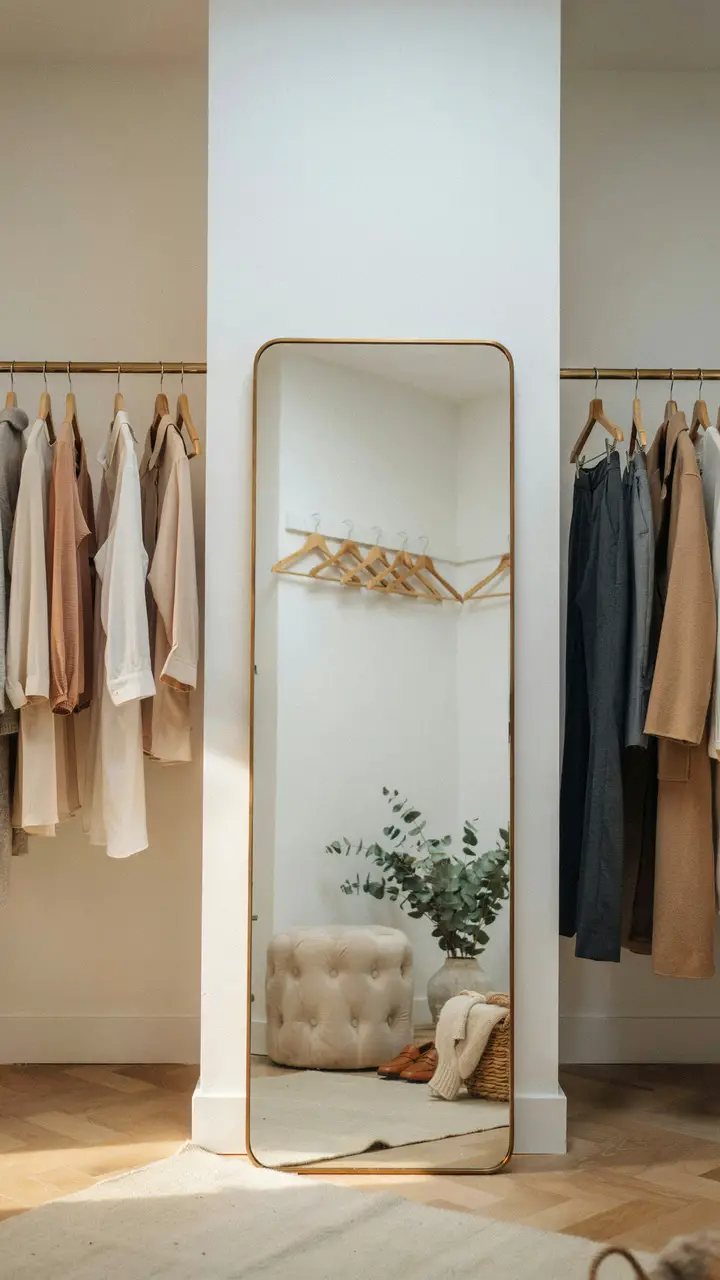
A full-length mirror is one of those additions that’s technically functional (can I actually see myself?) and also immediately makes a closet feel more like a real dressing room. The trick is in the placement—lean it rather than mount it if you’re renting, and position it where you get good light hitting your face, not backlighting you from behind.
Shopping list:
- Leaning full-length mirror (IKEA HOVET, Target, or HomeGoods): $50–$200 depending on frame
- Mirror adhesive strips or anti-tip strap for safety: $8–$15
- Optional: small clip-on task light for above the mirror if natural light is limited: $20–$40
Step-by-step:
- Position the mirror on the wall opposite or adjacent to your main light source
- Lean at a very slight angle back—straight vertical mirrors can distort your reflection slightly
- Secure with anti-tip furniture strap anchored into at least one stud; an unsecured mirror falling is a genuine safety hazard
- Place a small stool or bench nearby—trying on shoes while looking in the mirror is genuinely useful
Budget breakdown:
- Under $100: IKEA NISSEDAL or TARGET threshold mirror in simple frame = $40–$80
- $100–$500: Arched brass-framed leaning mirror or vintage-style ornate frame = $120–$300
- $500+: Custom built-in mirror with integrated lighting surround
Rental note: Leaning mirrors require zero wall damage and move with you. This is a genuinely perfect rental-friendly upgrade.
Common mistake: Choosing a mirror that’s too narrow. Full-length means full width—you want to see your entire outfit, not just a vertical sliver of yourself.
5. Add a Small Chandelier or Statement Light Fixture
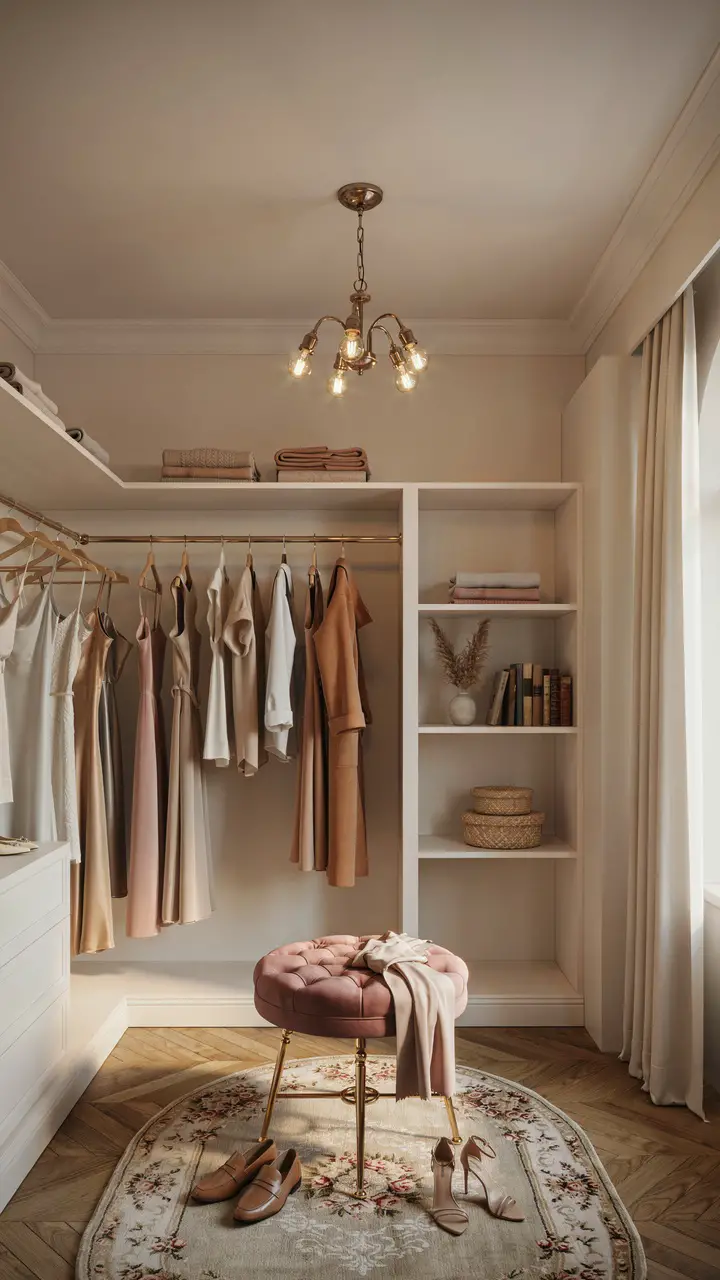
How to Recreate This Look
Here’s the decorating principle nobody tells you about closets: the light fixture is where you make the room. Every other closet has a flat LED panel. Yours can have a small chandelier, a rattan pendant, a sculptural globe, or an art deco semi-flush. The fixture costs the same as those other options and communicates completely different things about the space.
Shopping list:
- Small pendant or mini chandelier (6–14 inch diameter): $40–$250 depending on style
- Warm-toned LED bulbs (2700K): $8–$15 for a pack
- If replacing an existing fixture: wire nuts, electrical tape, a voltage tester—$10–$20 for supplies
Step-by-step:
- Turn off the circuit breaker before touching any wiring—this is non-negotiable
- If swapping an existing ceiling fixture, this is a straightforward DIY; if adding new electrical, hire an electrician
- Choose a fixture sized to your closet—a 6–10 inch diameter works in most walk-ins without overwhelming the space
- Hang at a height that clears your tallest hanging clothes by at least 12 inches
Budget breakdown:
- Under $100: Rattan or linen pendant shade with bulb = $40–$80
- $100–$500: Brass mini chandelier or sculptural semi-flush = $120–$280
- $500+: Custom or vintage fixture with professional installation
Difficulty level: Swapping an existing fixture is beginner-level. Adding new wiring is a job for a licensed electrician, full stop.
Common mistake: Choosing a fixture that’s too large. A 24-inch chandelier in a 6×8 closet looks like it wandered in from a ballroom.
6. Create a Color-Coded Clothing System
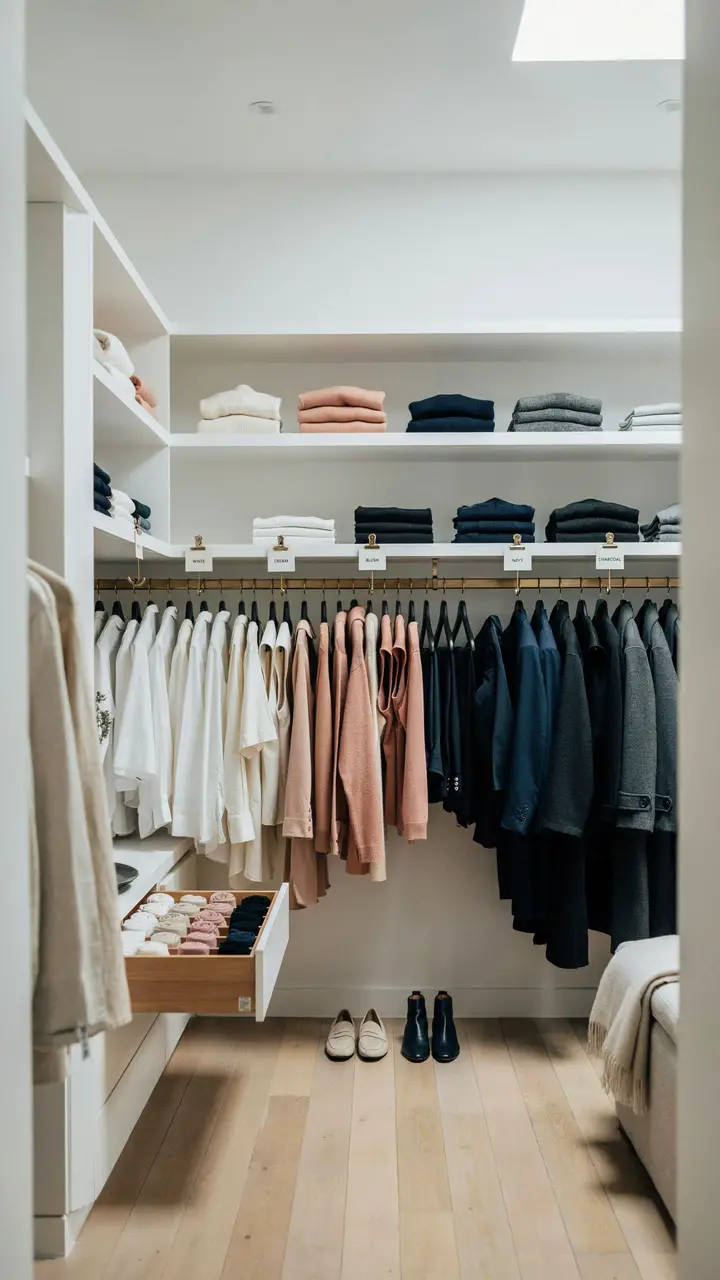
How to Recreate This Look
Color coding is one of those things that looks impressive but takes about forty minutes to implement. You’re not reorganizing your wardrobe—you’re just sorting what you already own by hue. The payoff is immediate: you can find the gray blazer in ten seconds instead of ten minutes, and your closet suddenly looks like it was professionally styled. 🙂
Shopping list:
- 50-pack uniform velvet hangers (all one color, ideally black or natural): $12–$18
- Optional section dividers with labels: $10–$20
- Small label card holder clips: $8–$12
Step-by-step:
- Remove everything, lay it on the bed, and sort into color groups: whites/creams, blush/pinks, reds, oranges, yellows, greens, blues, purples, grays, blacks, browns/neutrals
- Switch to uniform hangers before rehinging—this is the step most people skip and immediately regret
- Rehang by color group within each rod section
- Add a small clip-on divider between sections if you want clear visual boundaries
- Multicolor or printed items go at the end—don’t overthink it
Budget breakdown:
- Under $100: New uniform hangers + 30 minutes of your time = $15–$20
- $100–$500: Add custom section dividers, dedicated labeled zones, and premium matching storage bins
- $500+: Full closet redesign with built-in section separation and integrated lighting to highlight the color story
Difficulty level: Absolute beginner. If you can sort things by color, you can do this.
Durability note: Color coding only works if you put things back in the right place. Give yourself grace—a closet that’s 80% color coded and easy to use beats a pristine system that falls apart in three days.
7. Install Pull-Out Drawers or Bins for Accessories
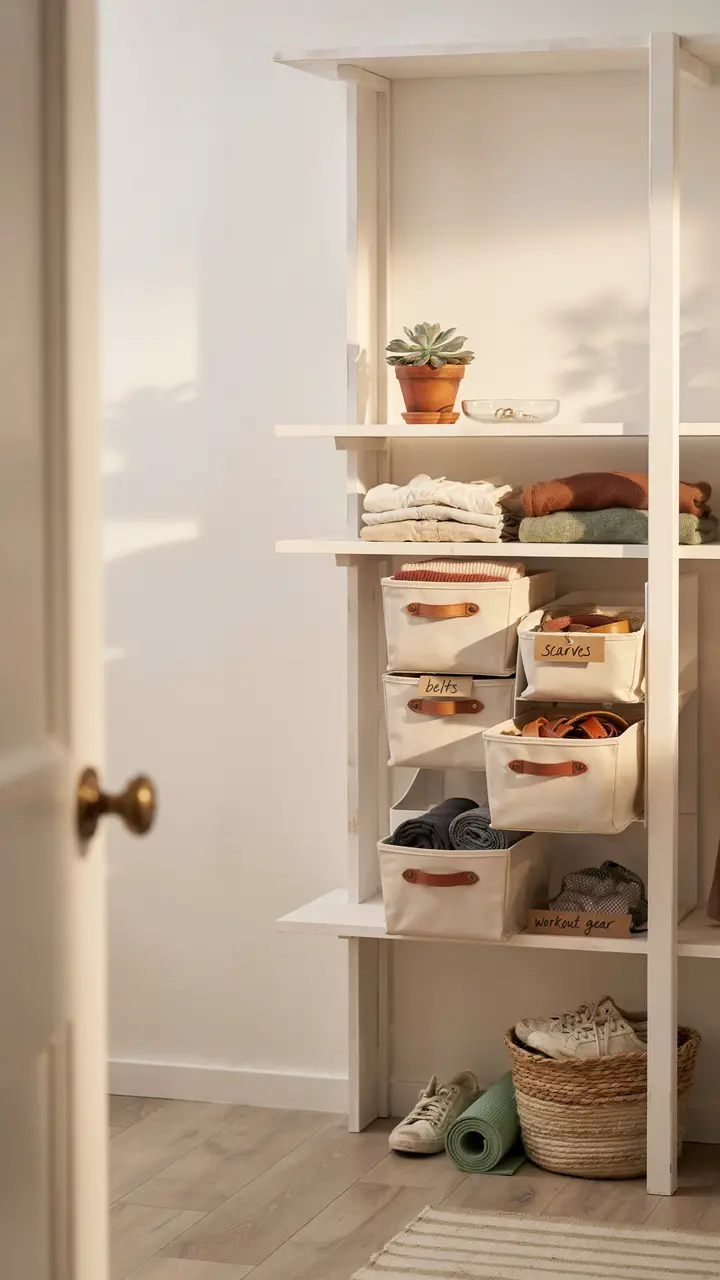
How to Recreate This Look
Accessories are the silent chaos-creators of most closets. Belts draped over rods, scarves stuffed into corners, workout headbands creating a textile avalanche in the back corner—these small items need their own dedicated containment system or they’ll undermine every other organization effort you make.
Shopping list:
- Canvas pull-out bins or open-top fabric drawers (IKEA SKUBB or similar): $5–$15 per bin
- A simple shelf unit to slide them into (IKEA KALLAX or similar): $40–$120
- Label maker or tag labels and a marker: $8–$20
Step-by-step:
- Identify your accessory categories: belts, scarves, hats, workout gear, bags/clutches, seasonal accessories
- Assign one bin per category—don’t combine unrelated items
- Label every bin clearly from the front so you can see at a glance without opening
- Place most-used bins at waist height for easy access
- Keep the bin system away from your main hanging area so it doesn’t feel cramped
Budget breakdown:
- Under $100: 6–8 canvas bins + basic shelf unit = $60–$90
- $100–$500: Matching linen pull-out drawers + custom labeled dividers + better shelf unit = $120–$250
- $500+: Built-in drawer inserts with custom compartments for jewelry and fine accessories
Lifestyle consideration: If you have kids who help themselves to your closet, clear-top bins with lids let you see contents without inviting random intrusion. Labeled bins also work incredibly well with neurodivergent organization styles—the visual cue removes the decision fatigue of “where does this go?”
Seasonal swap: Swap seasonal accessory bins (winter gloves/hats) to the top or back of the shelf system when out of season.
8. Incorporate Jewelry and Watch Display Storage
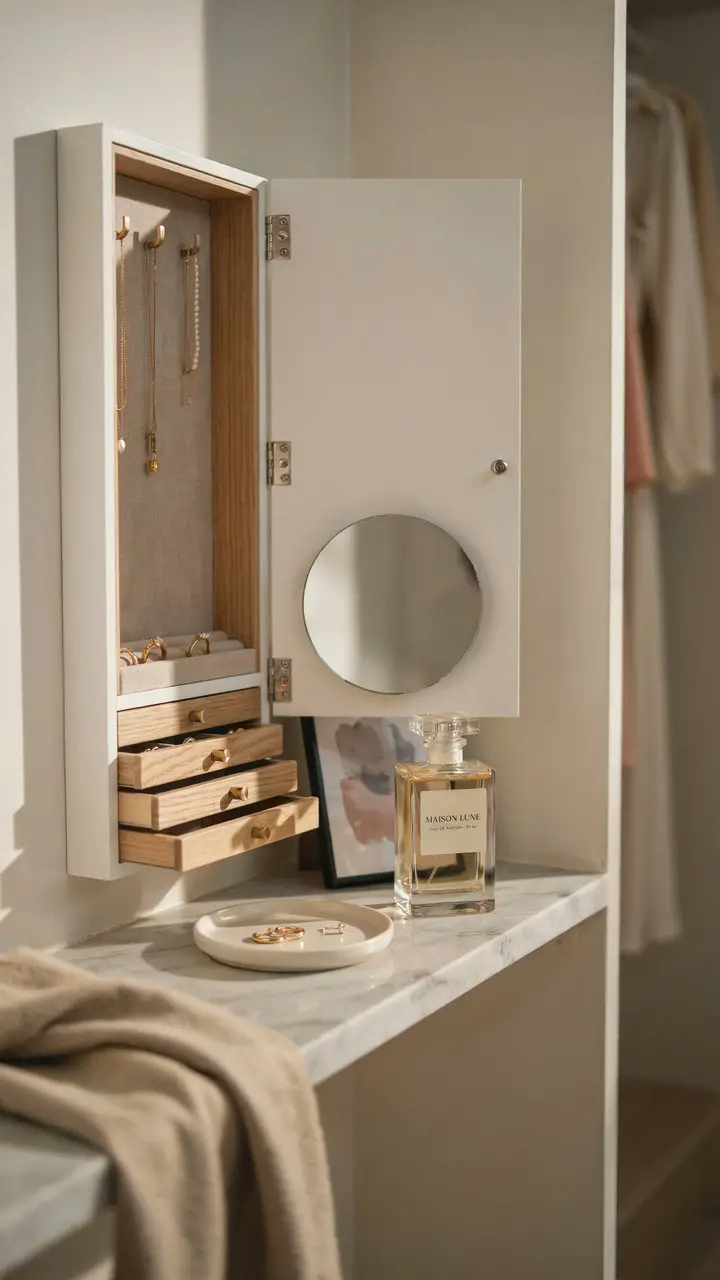
How to Recreate This Look
Jewelry that lives in a tangled pile inside a box is jewelry you never wear. The goal of jewelry storage isn’t just organization—it’s accessibility. If you can see it and reach it in thirty seconds, you’ll actually use your collection.
Shopping list:
- Wall-mounted or countertop jewelry organizer with hooks + ring roll: $25–$150
- Small ceramic tray or dish for frequently worn pieces: $10–$30
- Optional small framed print or perfume display: $15–$50 for a curated personal touch
Step-by-step:
- Sort jewelry by type: necklaces, earrings, rings, bracelets, watches
- Allocate a hook system for necklaces (this prevents the tangling problem entirely)
- Keep your “everyday” pieces in an open tray where you can grab them without opening a drawer
- Store fine or sentimental jewelry in a dedicated locked or hidden box within the armoire
- Wipe jewelry trays monthly—they gather dust and aerosol residue from hairspray and perfume
Budget breakdown:
- Under $100: A wall-mounted acrylic jewelry organizer + ceramic dish = $35–$75
- $100–$500: Upholstered countertop jewelry box with mirror + decorative tray styling = $120–$280
- $500+: Built-in jewelry drawer system with velvet lining and individual compartments
Common mistake: Buying a jewelry organizer with too many compartments for what you own. If the organizer looks half-empty, it just highlights what’s missing. Size it to what you have, not what you might accumulate.
9. Add a Small Bench or Stool
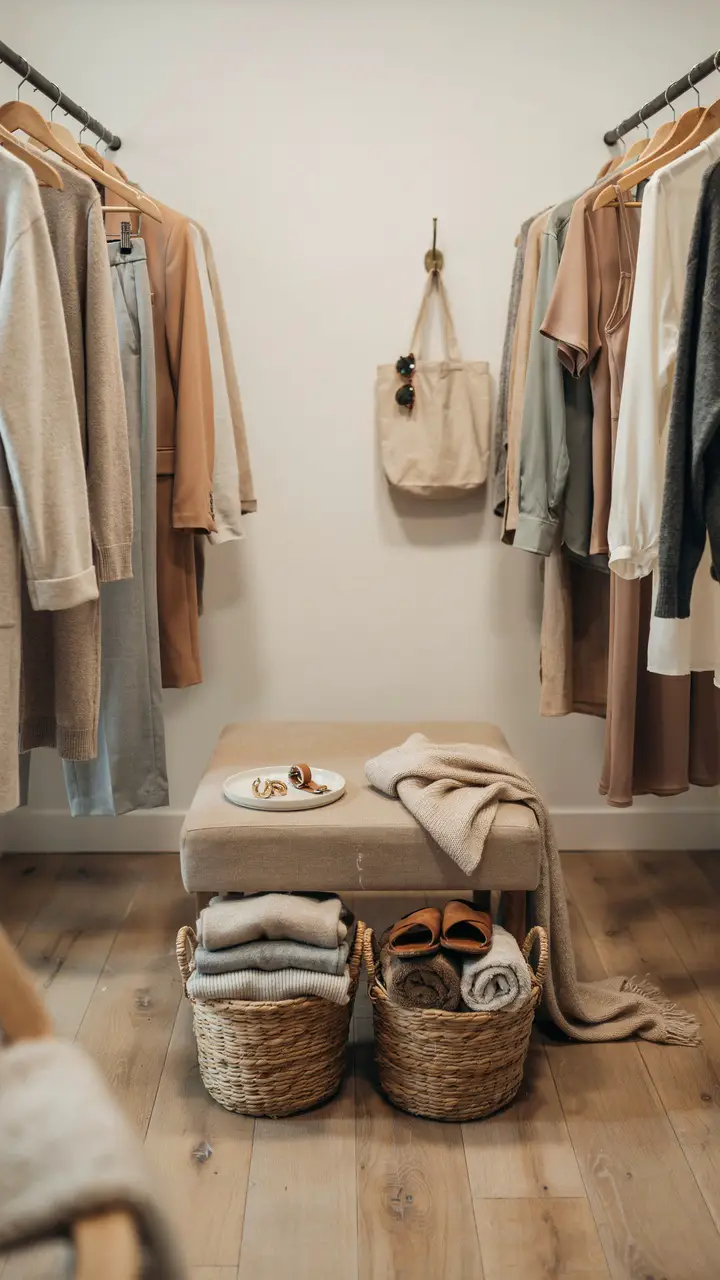
How to Recreate This Look
A bench in a walk-in closet sounds like a luxury until you’ve tried to put on a pair of boots while hopping on one foot in a narrow space. Even a small stool transforms the act of getting dressed from a balancing act into something that actually feels pleasant in the morning.
Shopping list:
- Upholstered bench or wooden stool (20–30 inches wide): $40–$250
- Two matching woven baskets to tuck beneath: $20–$50 each
- Optional tray for the top surface: $15–$30
Step-by-step:
- Measure your closet’s center aisle—you need at least 18 inches of clearance on each side of the bench to move comfortably
- Choose an upholstered surface in a durable, wipeable fabric if you have kids or pets (performance velvet or indoor-outdoor linen are excellent)
- Tuck baskets beneath for bonus storage: seasonal items, extra linens, shoe care supplies
- Keep the top surface intentional—one folded blanket or a small tray looks styled; a pile of miscellaneous items looks like a dumping ground
Budget breakdown:
- Under $100: IKEA SKOGSTA bench or a thrifted wood stool + new cushion = $40–$85
- $100–$500: Upholstered storage ottoman bench = $120–$280
- $500+: Custom built-in window seat with under-seat drawers if space permits
Space requirements: Works in closets with a center aisle at least 3.5 feet wide. In tighter spaces, a backless stool (rather than a bench) takes up far less visual real estate while still serving the purpose.
Difficulty level: Zero difficulty. You’re placing a piece of furniture. This might be the most accessible upgrade on this entire list.
10. Style with Intentional Lighting Zones
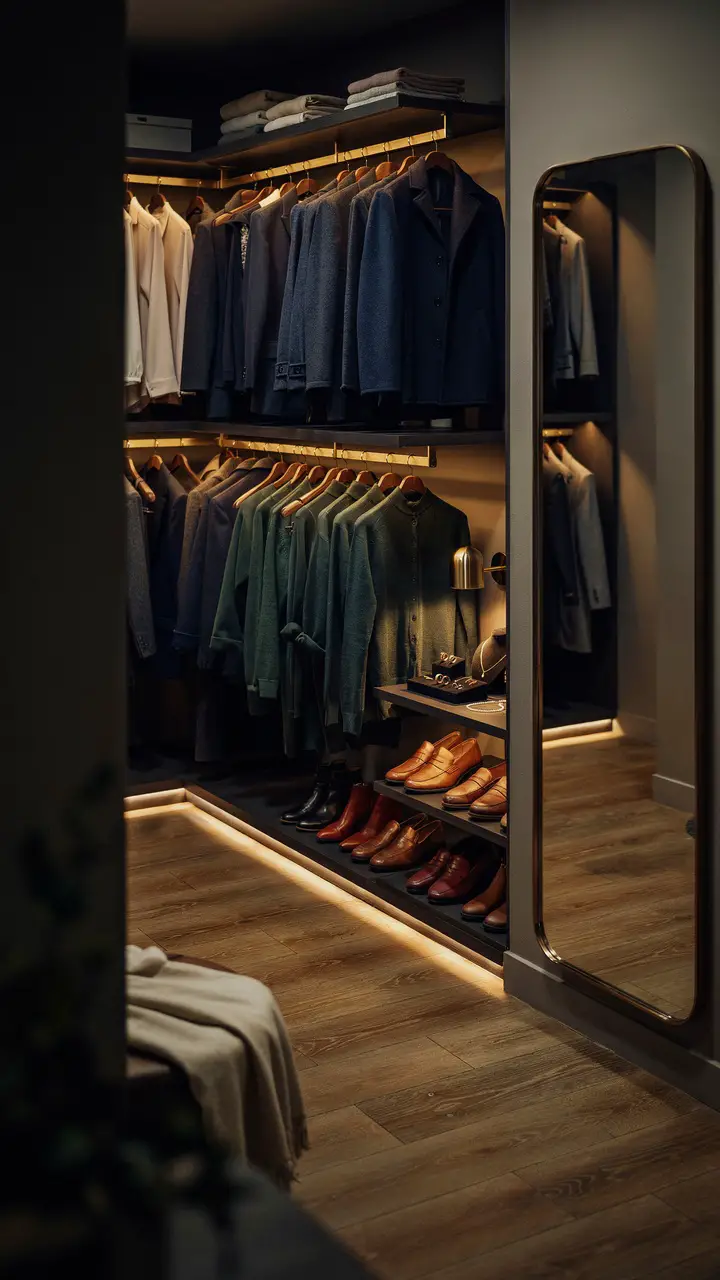
How to Recreate This Look
Most walk-in closets have one overhead light that does a mediocre job of illuminating everything equally. Layered lighting—a general source plus task lighting in key zones—changes not just visibility but how the entire space feels. This is genuinely one of the highest-return upgrades for the least amount of construction.
Shopping list:
- LED strip lights with adhesive backing (warm white, 2700K): $15–$35 for a 6-foot roll
- Small battery-operated puck lights for shoe shelves or dark corners: $12–$25 for a 3-pack
- Optional: small wall sconce with plug-in cord (no hardwiring required): $30–$100
- Smart plug or dimmer switch to control the ambiance: $12–$25
Step-by-step:
- Map the dark zones in your closet—where can you not clearly see colors or read labels?
- Apply LED strip lighting to the underside of upper shelves pointing downward onto hanging clothes
- Place puck lights inside shoe cubbies or on the floor of lower shelf sections
- If adding a wall sconce, choose a plug-in style that drapes the cord along a wall edge rather than requiring new electrical work
- Set all lights on a smart plug so you can control them from outside the closet with one tap
Budget breakdown:
- Under $100: LED strip lights + 3-pack puck lights + smart plug = $40–$80
- $100–$500: Add a plug-in wall sconce + premium LED strips with color temperature control = $130–$280
- $500+: Hardwired recessed lighting in zones with a dedicated dimmer switch, professionally installed
Rental note: Adhesive LED strips, puck lights, and plug-in sconces leave zero wall damage and come down in minutes. This entire lighting system is 100% renter-friendly.
Common mistake: Using cool white LEDs (5000K+) in a closet. They make every color look slightly wrong and the space feel clinical. Stick to warm white (2700K–3000K) for clothing storage areas—it’s the same light quality that makes clothing look its best in stores.
Your Closet Reflects How You Start Your Day
Here’s what all ten of these ideas have in common: none of them require a gut renovation, a big budget, or a professional designer. They work because they address the real, daily friction points of a closet—poor visibility, tangled accessories, wasted vertical space, and no place to sit while you figure out what your feet are doing.
The closet you want isn’t about having more stuff in a beautiful space. It’s about having a space that makes the ritual of getting dressed feel like something you’ve set up for yourself, not something you’re enduring.
Start with one idea. See how it changes how you feel when you open that door in the morning. Then add another. This is exactly how beautiful, functional spaces are built—not all at once, but one good decision at a time. <3

Greetings, I’m Alex – an expert in the art of naming teams, groups or brands, and businesses. With years of experience as a consultant for some of the most recognized companies out there, I want to pass on my knowledge and share tips that will help you craft an unforgettable name for your project through TeamGroupNames.Com!