
There’s something deeply satisfying about opening a closet door and seeing everything exactly where it belongs.
Not the “shove it in and pray the door closes” kind of organized—the actually organized kind, where you can find your favorite jeans in under ten seconds and your shoes aren’t auditioning for a game of Jenga every morning.
If your master bedroom has a walk-in closet that’s technically walk-in but practically a walk-into-chaos situation, you’re in great company.
Small walk-in closets are one of the most common decorating frustrations I hear about, and honestly? They’re also one of the most satisfying spaces to transform.
The good news is that you don’t need to gut the whole thing or hire a custom closet company charging three times your monthly rent to make it work beautifully.
Whether you’re renting and can’t touch the walls, working with a seriously tight budget, or just finally fed up with the Sunday morning outfit scramble, these ten ideas will help you turn your small master walk-in closet into a space that feels intentional, functional, and maybe even a little luxurious.
Ready? Let’s figure out what your closet’s been missing. 🙂
1. Double Your Hanging Space With a Second Rod
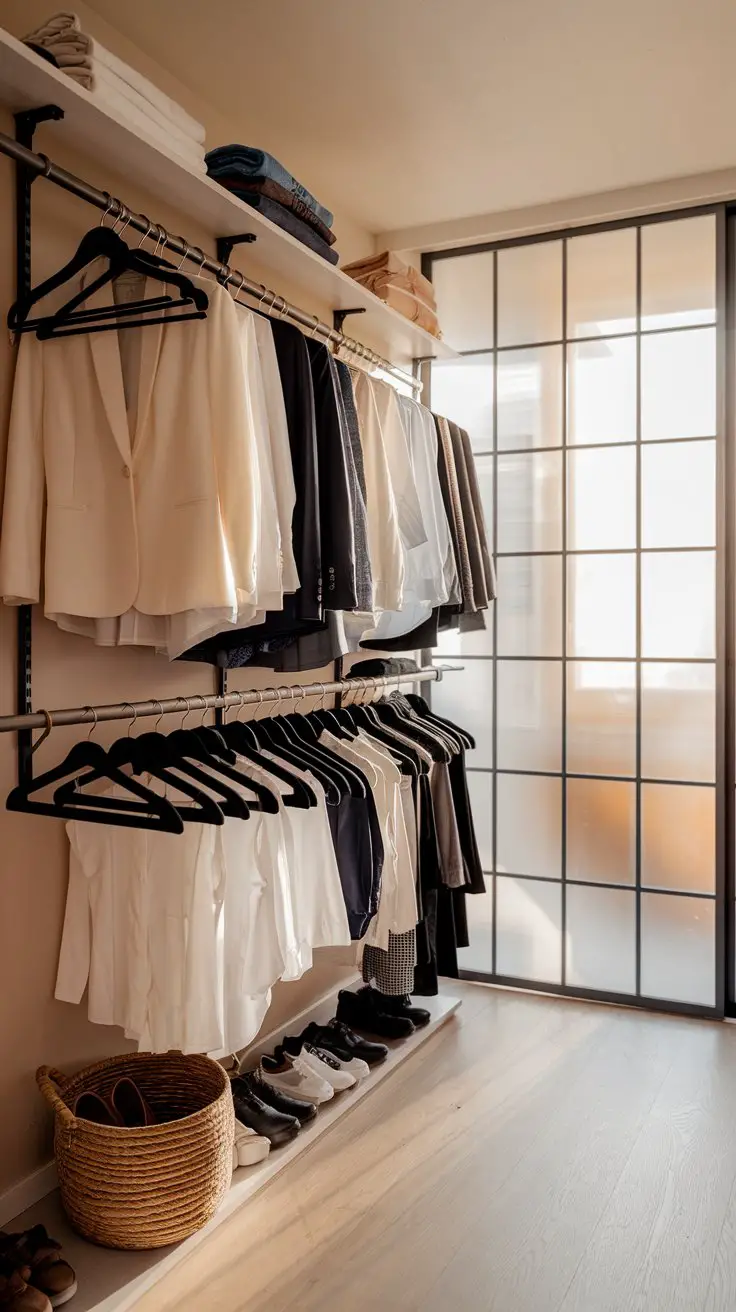
If your closet currently has one single rod running wall to wall, you’re leaving roughly half your storage potential completely unused. Most tops, jackets, blazers, and folded trousers only need about 36–40 inches of vertical clearance—meaning everything above and below that zone is just… air.
Adding a second hanging rod underneath your existing one immediately doubles your short-item hanging capacity without touching a single wall.
How to Recreate This Look
Shopping List:
- Closet rod extender (hooks onto existing rod, drops down a second bar): $15–$35 at Target, Amazon, or IKEA
- OR a freestanding double-hang unit in powder-coated steel or wood finish: $45–$120 at The Container Store, Wayfair, or HomeGoods
- Slim velvet non-slip hangers (50-pack): $18–$25 on Amazon — these alone will recover 30% more rod space than plastic hangers
- Small wicker or fabric bins for the floor below: $10–$20 each at TJ Maxx or thrift stores
Step-by-Step Styling:
- Sort your clothing into “short hang” (tops, jackets, folded pants) and “long hang” (dresses, full-length trousers) before installing anything
- Install or hang your second rod at a height that gives your longest short-hang item about 2 inches of clearance below
- Switch all hangers to velvet slim-profile before rehanging—this step alone makes the whole system look intentional
- Color coordinate each rod section: lightest to darkest, or by category (work, casual, weekend)
- Use the floor space under the lower rod for a small shoe rack, a basket of gym gear, or a single row of boots
Budget Breakdown:
- Under $100: Rod extender + velvet hangers + one fabric bin — completely transforms function for around $55
- $100–$500: Freestanding double-hang unit + velvet hangers + matching bins — polished and sturdy at $150–$200
- $500+: Custom built-in double-hang section with integrated lighting — $600–$1,200 depending on contractor
Difficulty Level: Beginner — no tools required for the rod extender version; a drill and level needed for a mounted second rod (intermediate, 1–2 hours)
Lifestyle Notes: Velvet hangers are not pet-hair friendly if your cat considers your closet a vacation home. Opt for the extender rod version over mounted rods in rentals—no wall damage.
Common Mistake: Hanging long dresses on your double-hang side and wondering why everything bunches. Sort ruthlessly before you install.
2. Use the Back Wall for Floor-to-Ceiling Shelving
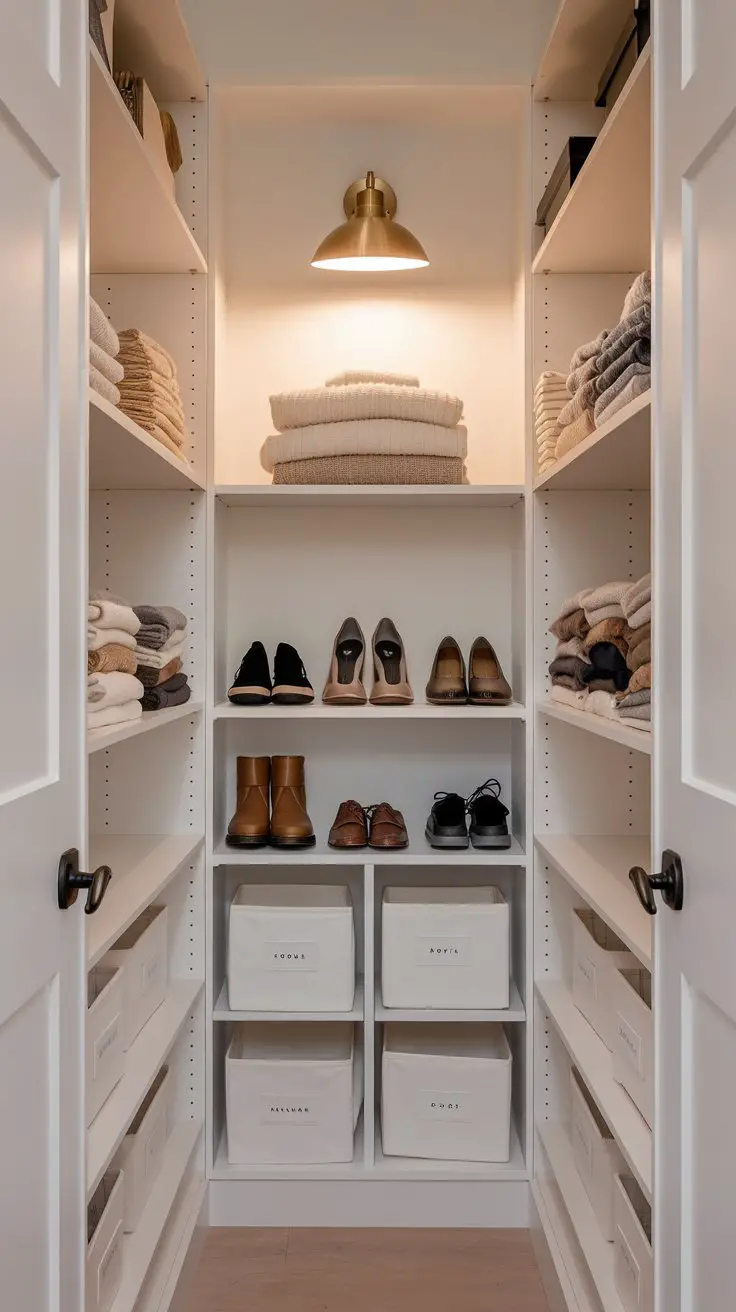
The back wall of most walk-in closets gets completely ignored. It becomes a dumping ground for dry cleaning bags, that exercise bike you’re definitely going to use again, and mystery boxes from the last move. That wall is prime real estate—treat it like it.
Floor-to-ceiling open shelving on the back wall gives you a visual anchor for the entire closet while adding enormous storage for folded items, shoes, bags, and bins.
How to Recreate This Look
Shopping List:
- IKEA BILLY bookcase (white, customizable heights): $60–$120 per unit — two units side by side cover most standard back walls
- OR freestanding ladder shelves for renters: $45–$95 at Amazon or Wayfair
- Fabric storage bins in matching neutral tones (set of 6): $30–$50 at The Container Store or IKEA
- Acrylic shoe risers (set of 12): $20–$35 on Amazon
- Removable LED picture light (battery-operated, brass finish): $25–$45 on Amazon
Step-by-Step Styling:
- Measure your back wall width and ceiling height before purchasing — account for 2–3 inches clearance from side walls
- Assemble shelving units flat before moving into the closet (your future self will thank you)
- Anchor to the wall if you own the space; use anti-tip furniture straps for renters
- Place heavy folded items (jeans, sweaters) at eye level and below — reaching overhead for heavy stacks is a guaranteed avalanche
- Use the top shelves for seasonal items in labeled bins — holiday sweaters don’t need to be accessible in July
- Style shoes in forward-facing pairs with risers to double visible pairs per shelf
Budget Breakdown:
- Under $100: Two ladder shelves + fabric bins — functional and surprisingly tidy at $85–$95
- $100–$500: IKEA BILLY units + shoe risers + bins + lighting — polished and sturdy at $200–$280
- $500+: Custom built-in floor-to-ceiling shelving with integrated LED strips — $800–$2,500 depending on finish and contractor
Difficulty Level: Beginner to Intermediate — freestanding options require zero tools; IKEA assembly takes 2–4 hours
Durability: Open shelving with folded items collects dust faster than closed bins. A light weekly fold-and-dust keeps it looking editorial. Not ideal if you have a dog who considers closets a personal playground.
Seasonal Swap: Rotate seasonal bins top-to-bottom twice a year. Summer linens go up top in winter; heavy knits come down.
3. Add a Slim Island or Bench for Folding and Jewelry Storage
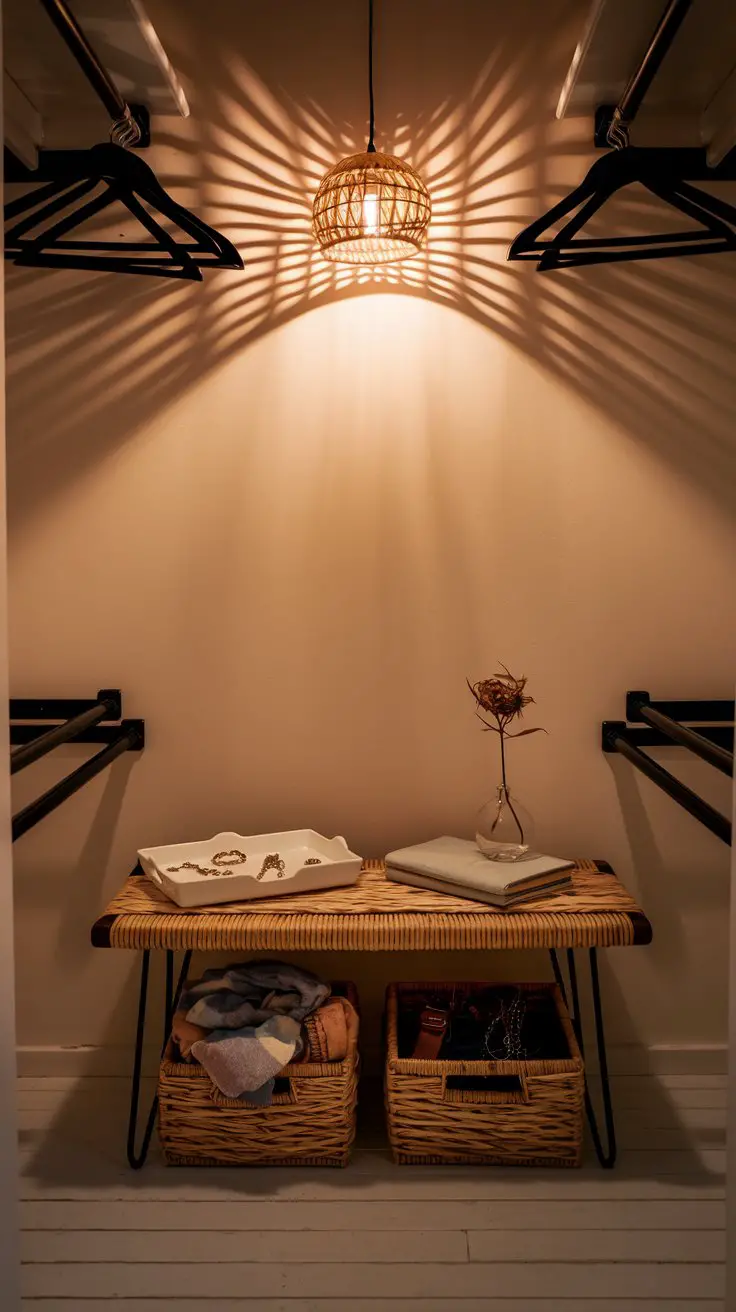
Here’s the closet tip nobody talks about: a surface to put things down changes everything. Without one, you’re draping tomorrow’s outfit over the rod, balancing your jewelry on the shelf edge, and doing the one-legged-shoe-putting-on dance in the doorway.
A slim bench or narrow console table in the center of your walk-in adds function and instantly makes the closet feel more like a dressing room.
How to Recreate This Look
Shopping List:
- Slim hairpin-leg bench or console (16–20 inches wide maximum): $65–$150 at West Elm, Target, or thrifted from Facebook Marketplace
- Small ceramic or wooden tray for jewelry: $15–$30 at HomeGoods or TJ Maxx
- 2 wicker under-bench baskets: $20–$40 at IKEA or thrift stores
- Small bud vase + dried stems: $8–$15 total
Step-by-Step Styling:
- Measure your closet’s center aisle — you need a minimum 24-inch clearance on each side of the bench to open clothing without frustration
- Keep the bench surface deliberately minimal: one tray, one small plant or vase, and nothing else
- Use under-bench baskets for accessories that don’t hang — belts, scarves, gym socks (the glamorous reality of real closets)
- If space is too tight for a bench, mount a narrow floating shelf at hip height on the back wall as a surface alternative — $20–$40 in brackets and a wooden plank
Budget Breakdown:
- Under $100: Thrifted console + tray + baskets — $60–$80
- $100–$500: West Elm slim bench + matching tray + wicker baskets — $150–$220
- $500+: Custom upholstered ottoman with interior storage — $400–$800
Difficulty Level: Beginner — no installation required for freestanding bench
Minimum Space Requirement: Your closet aisle needs to be at least 5 feet wide for a bench to work comfortably. In tighter spaces, go floating shelf instead.
4. Install a Pegboard Panel for Bags, Belts, and Accessories
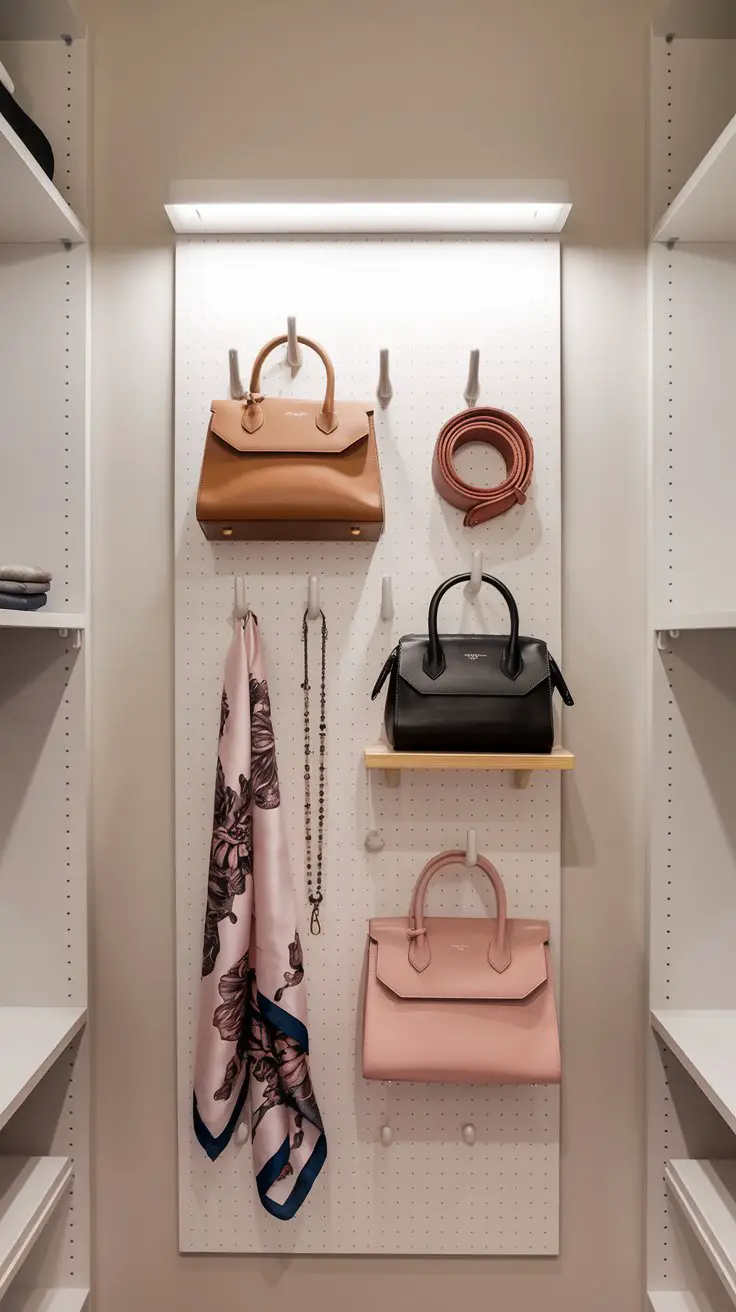
Bags and belts are the most difficult accessories to store in a small closet — they’re bulky, they tangle, and they inevitably end up in a pile in the corner getting scratched and deformed. A pegboard panel solves this in about two hours on a Saturday morning.
Pegboard is renter-friendly when surface-mounted with picture-hanging strips, endlessly reconfigurable, and genuinely one of the most satisfying DIY closet projects you’ll ever tackle.
How to Recreate This Look
Shopping List:
- 2’x4′ or 3’x4′ white or black pegboard panel: $15–$30 at Home Depot or Lowe’s
- Pegboard hook variety pack (30–50 pieces): $12–$20 on Amazon
- 1-inch standoff mounting hardware (allows hooks to insert fully): $8–$15
- OR Command large picture-hanging strips for renter-safe mounting: $12–$18
- Spray paint in matte white, black, or color of your choice (if panel needs painting): $6–$10
Step-by-Step Styling:
- Paint the pegboard before mounting — so much easier flat on the ground
- Plan your hook layout before installing: bags need double hooks spaced 4–6 inches apart, belts need single curved hooks, jewelry needs small cup hooks
- Mount with standoffs (or thick washers) to ensure hooks insert properly — flush-to-wall pegboard won’t accept hooks
- Hang the heaviest items (bags) at eye level; lighter accessories above and below
- Leave 30% of the pegboard empty — this gives you room to add things and keeps it looking intentional rather than chaotic
Budget Breakdown:
- Under $100: Full pegboard setup including paint, hardware, and hooks — $55–$75
- $100–$500: Larger custom-cut panel + brass hooks + integrated LED strip — $120–$180
- $500+: Built-in accessory wall with custom cubbies, mirror, and lighting — $600+
Difficulty Level: Beginner to Intermediate — 1.5–2 hours, basic drill required for standoff mounting
Renter Note: Three or four large Command strips hold a painted pegboard panel safely. Test weight capacity with your heaviest bag first.
5. Maximize Vertical Space With a Stacked Shoe Wall
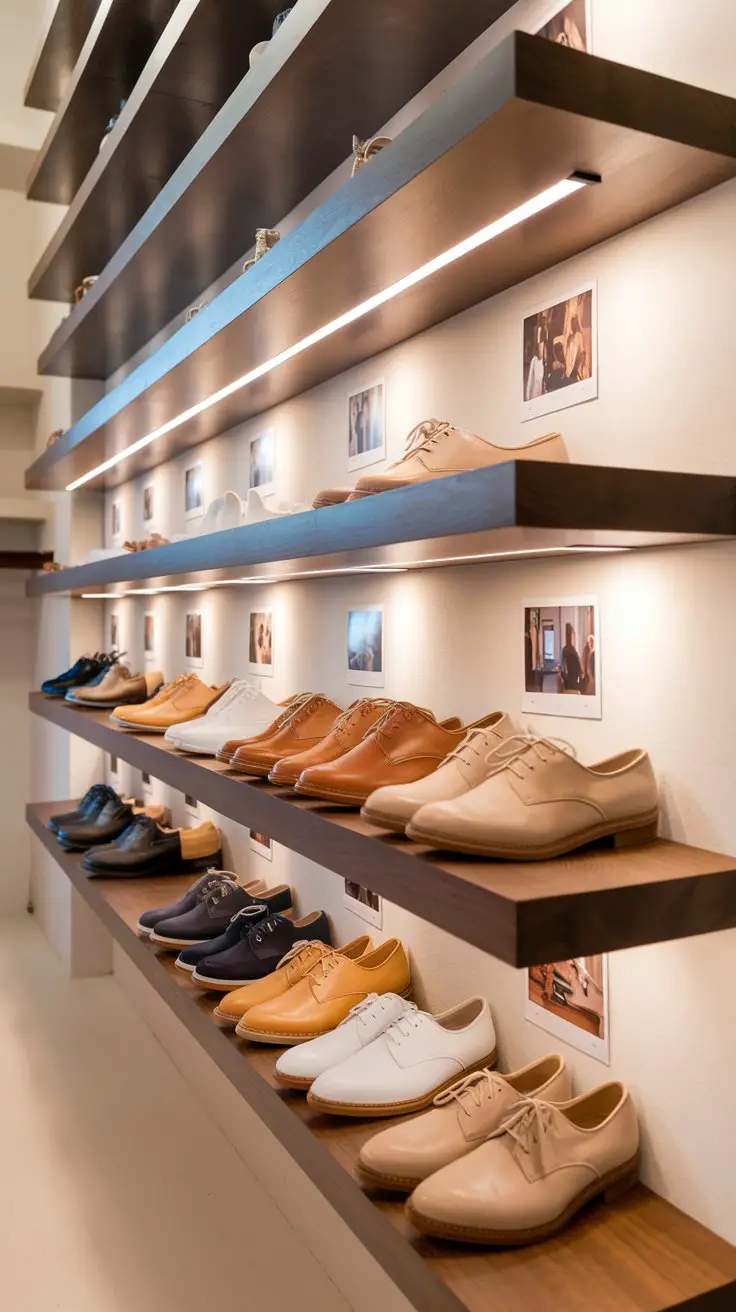
If shoes are running your closet’s life (and honestly, respect), dedicating one full wall to floating shoe shelves transforms both the function and the entire feeling of the space.
The visual impact of an organized shoe wall is genuinely dramatic. It also forces you to edit your collection, because every pair needs to earn its visible spot.
How to Recreate This Look
Shopping List:
- Floating wall shelves, 36 inches wide (you’ll need 6–10 depending on collection size): $12–$25 each at IKEA (LACK shelves), Target, or Amazon
- Adhesive LED light strips (warm white, under-shelf): $18–$30 for a full set on Amazon
- Level and pencil for mounting: free if you already own one, $8 at any hardware store
- Drywall anchors if not mounting into studs: $6–$10
Step-by-Step Styling:
- Decide on shelf spacing — heels need about 7 inches of clearance, sneakers 5–6 inches, boots may need a double-height section
- Mount the lowest shelf at 12–15 inches from the floor — leaves room for tall boots to stand flat beneath
- Work upward, using a level obsessively (crooked shelves haunt you forever in a shoe wall)
- Style shoes toe-forward in a single row per shelf — resist the urge to double-stack, it negates the whole beautiful display
- Add adhesive LED strips under each shelf — this is the detail that makes it look genuinely boutique-level
Budget Breakdown:
- Under $100: 6 IKEA LACK shelves + LED strips — $90–$100
- $100–$500: 10 shelves + premium LED strips + wall paint refresh — $180–$280
- $500+: Custom walnut floating shelves with integrated wiring — $700–$1,500
Difficulty Level: Intermediate — mounting requires a drill, level, and patience; 3–4 hours for a full wall
Common Mistake: Mounting all shelves at equal height before accounting for different shoe heights. Measure your actual shoes first.
6. Use an Over-the-Door Organizer for Hidden Storage
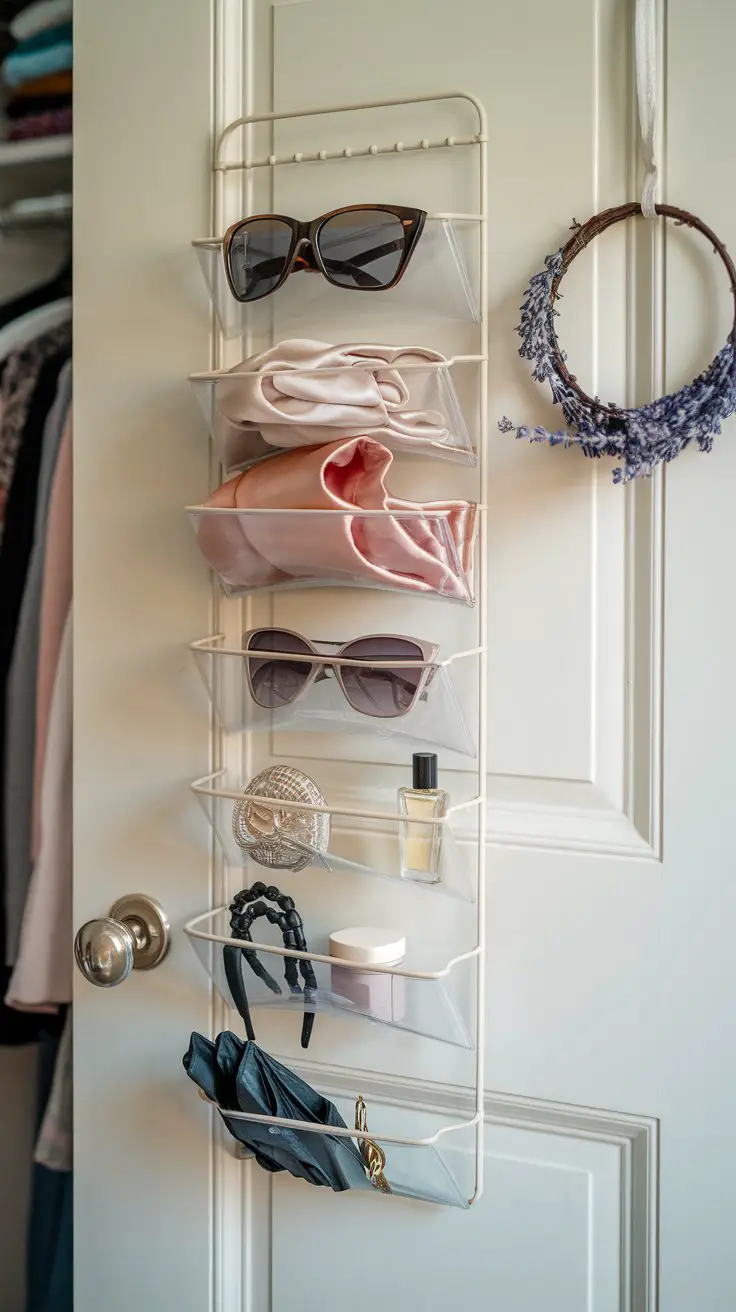
The back of your closet door is the most underused real estate in the entire bedroom. It’s essentially a free wall that no one thinks to use, and an over-door organizer turns it into serious storage for all the small things that clutter your shelves.
This is also the single best renter-friendly storage upgrade you can make — no installation, no wall damage, no landlord conversations.
How to Recreate This Look
Shopping List:
- Over-door organizer with clear pockets or metal slots: $20–$45 at The Container Store, Target, or Amazon
- Over-door hook set (4–6 hooks) for bags or robes to hang outside: $12–$20
- Optional: small adhesive mirror on the inner door surface: $15–$30
Step-by-Step Styling:
- Categorize what you’ll store before choosing your organizer — clear pockets for accessories and small items, metal slots for shoes, wire racks for bags
- Hang at a height where top pockets are reachable without tiptoeing
- Keep the organizer to maximum 70% full — overstuffed pockets defeat the organization and look chaotic when the door opens
- Add a small adhesive mirror below the organizer for a quick full-face check without leaving the closet
Budget Breakdown:
- Under $100: Over-door organizer + hook set — $35–$65 total
- $100–$500: Premium linen-pocket version + hooks + mirror — $95–$130
Difficulty Level: Beginner — 5 minutes to hang, zero tools
7. Create a Dedicated Jewelry Station With a Wall-Mounted Organizer
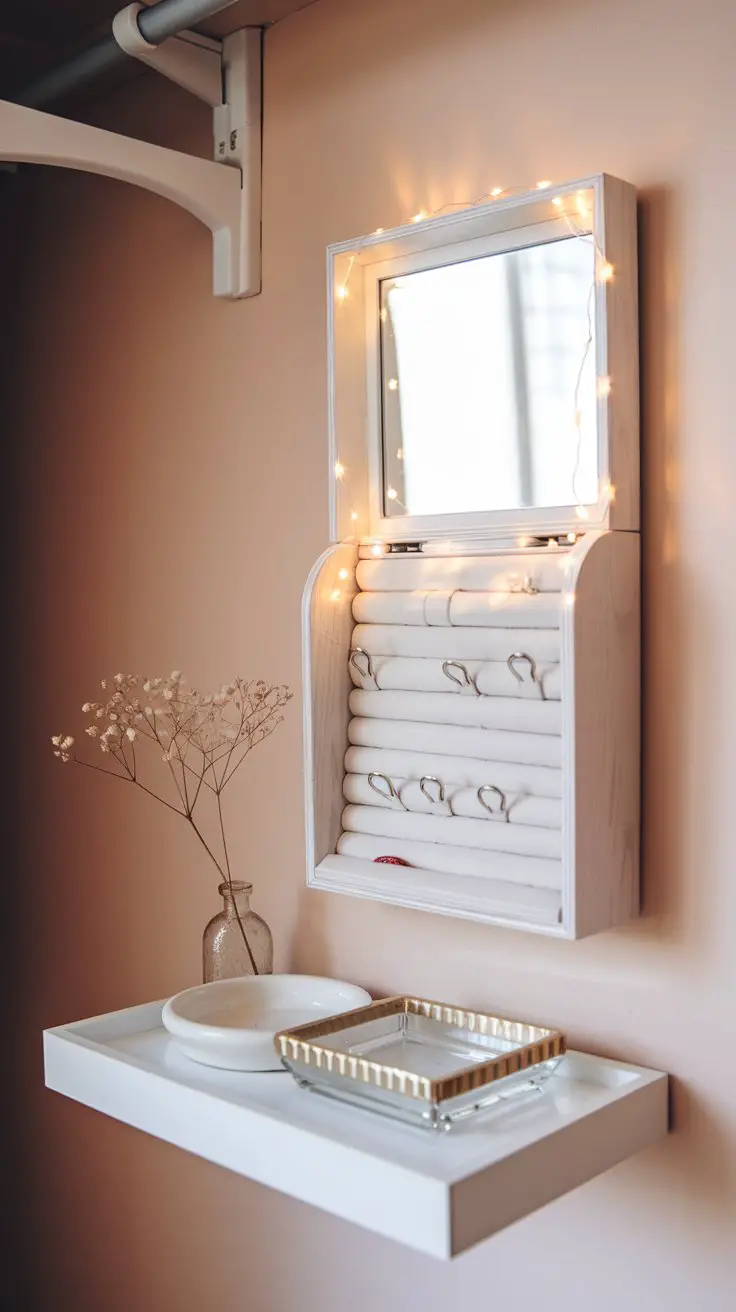
Jewelry scattered across a dresser top, tangled in a drawer, or—the worst—doing the disappearing single-earring act somewhere in the carpet, is a daily frustration that a dedicated jewelry station completely eliminates.
A wall-mounted jewelry organizer with a built-in mirror is one of the best dual-function purchases for a small master closet. It stores, displays, and gives you a mirror all in one footprint.
How to Recreate This Look
Shopping List:
- Wall-mounted jewelry organizer with mirror (wood or linen finish): $45–$120 at Amazon, Pottery Barn, or TJ Maxx
- Adhesive LED fairy lights for interior: $8–$15
- Small ceramic ring dish: $12–$20 at HomeGoods
- Floating shelf below (if desired): $15–$30
Step-by-Step Styling:
- Mount at eye level — you’ll use the mirror daily, so positioning matters
- Sort jewelry by type before hanging: necklaces on long hooks, rings on rolls, earrings on mesh panels
- Line the interior with fairy lights before filling — adds warmth and makes finding pieces at night genuinely easier
- Keep the shelf below intentional: one tray, one small vase, nothing else
Budget Breakdown:
- Under $100: Budget jewelry organizer + fairy lights + ring dish — $75–$90
- $100–$500: Linen or wood premium organizer + floating shelf + styling — $130–$200
Difficulty Level: Beginner — two wall screws and a level, 20 minutes total
8. Add Lighting That Actually Lets You See What You Own
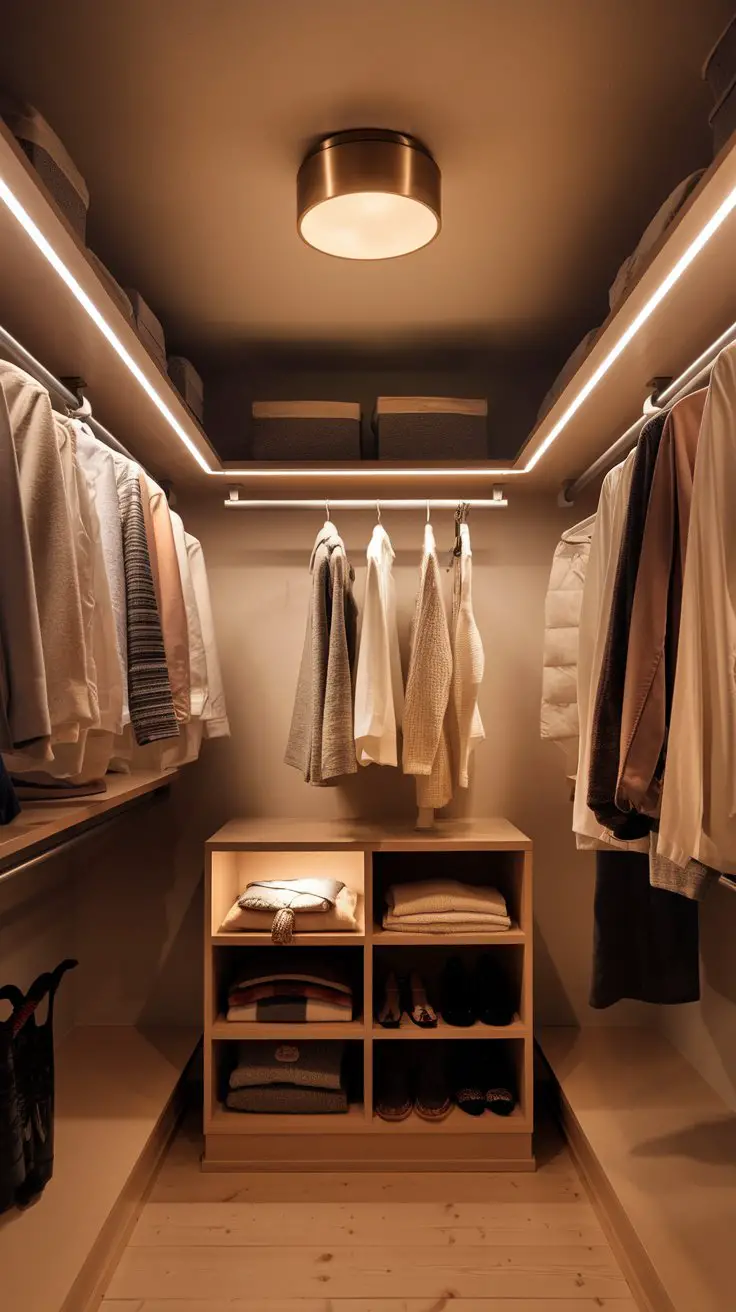
Here’s something nobody warns you about: decorating your closet beautifully means nothing if the lighting turns every color into a brownish mystery. FYI, this is why you’ve grabbed what you thought was charcoal grey and arrived at work in navy blue.
Good closet lighting is the single most underrated upgrade in any master bedroom closet. It also makes the space feel instantly more luxurious.
How to Recreate This Look
Shopping List:
- Battery-operated LED closet light bar with motion sensor: $15–$30 on Amazon (perfect for renters — zero wiring)
- Adhesive LED strip lights (warm white, 2700K–3000K for true color rendering): $18–$35
- Small adhesive puck lights for deep shelves or drawers: $12–$20 for a 3-pack
- If hardwired is possible: flush-mount ceiling light in brushed brass or matte black: $45–$120 at Home Depot or Wayfair
Step-by-Step Styling:
- Install your main overhead source first — a bright, even ceiling fixture eliminates the worst of closet shadow
- Add LED strip under each shelf section — run along the front underside edge for maximum downward throw
- Place puck lights inside any deep cubbies where overhead light doesn’t reach
- Stick to 2700K–3000K color temperature for warm white that renders clothing colors accurately without the yellow tinge of old incandescent bulbs
Budget Breakdown:
- Under $100: Motion-sensor bar + LED strips + puck lights — $55–$85
- $100–$500: Flush-mount ceiling fixture + full LED strip system — $120–$220
- $500+: Integrated lighting design with dimmers and hardwired under-shelf LEDs — $600–$1,500
Difficulty Level: Beginner (battery/adhesive options) to Advanced (hardwired installation)
9. Install a Slim Mirror to Visually Double the Space
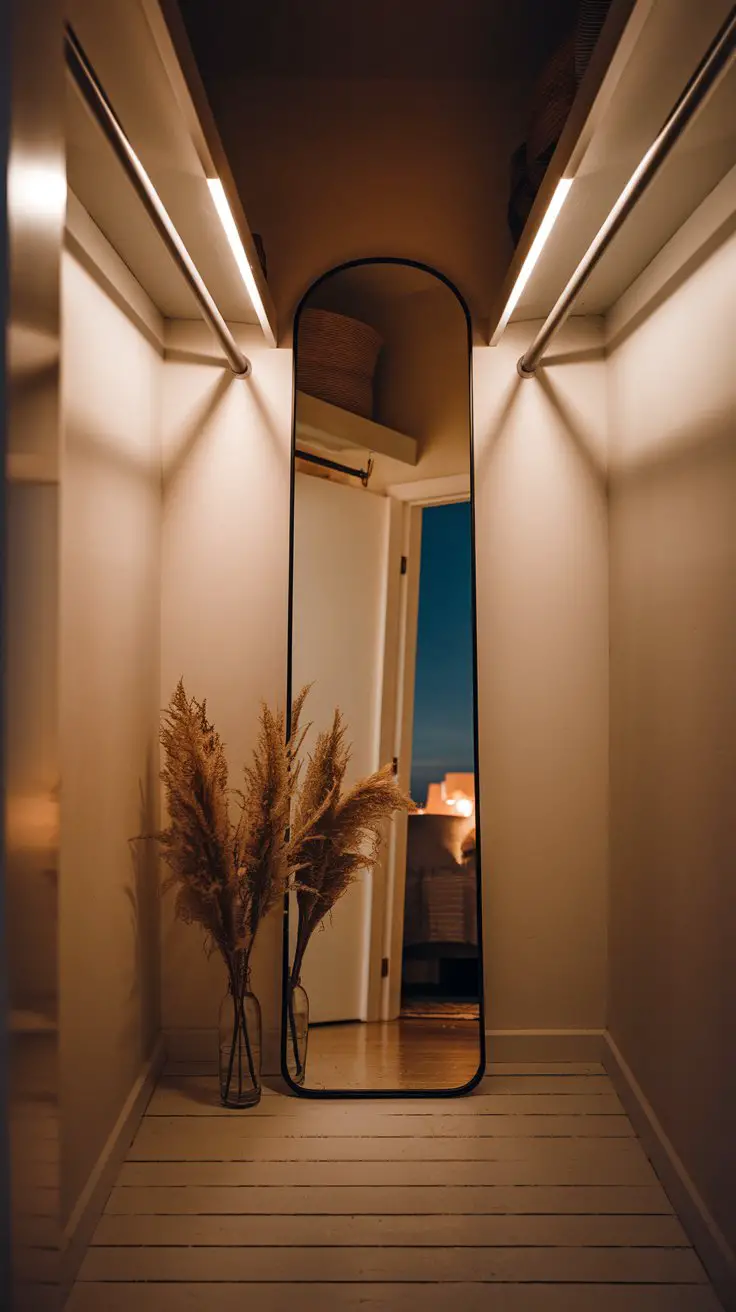
A full-length mirror in a small walk-in closet does two things simultaneously: it gives you a place to actually check your full outfit, and it visually doubles the perceived size of the entire space. It’s the oldest interior design trick in the book, and it works every single time.
Leaning mirrors are 100% renter-friendly, take zero installation, and look intentionally styled rather than utilitarian.
How to Recreate This Look
Shopping List:
- Full-length leaning mirror in thin metal frame (matte black, brass, or natural wood): $45–$180 at Target, IKEA (HOVET), Wayfair, or thrifted
- Small adhesive mirror safety backing strips: $8–$12 (prevents tipping — worth every penny)
- Optional: a small vase of dried botanicals for beside the base — $10–$20
Step-by-Step Styling:
- Position the mirror on the wall that best reflects the widest part of your closet — usually the wall opposite your main clothing rods
- Lean at a very slight angle back against the wall — this creates a flattering full-length view and reduces tipping risk
- Apply safety backing to the base on the floor side
- Style the base with one simple object — a vase, a small basket, a candle — never more than two items, or it clutters the reflection
Budget Breakdown:
- Under $100: Thrifted or IKEA HOVET leaning mirror — $50–$75
- $100–$500: West Elm or Anthropologie style thin-frame leaner — $120–$250
- $500+: Custom-framed or antique gilt leaning mirror — $500–$1,200
Difficulty Level: Beginner — leans against wall, no tools
10. Design a Capsule Wardrobe Zone to Reduce Visual Clutter
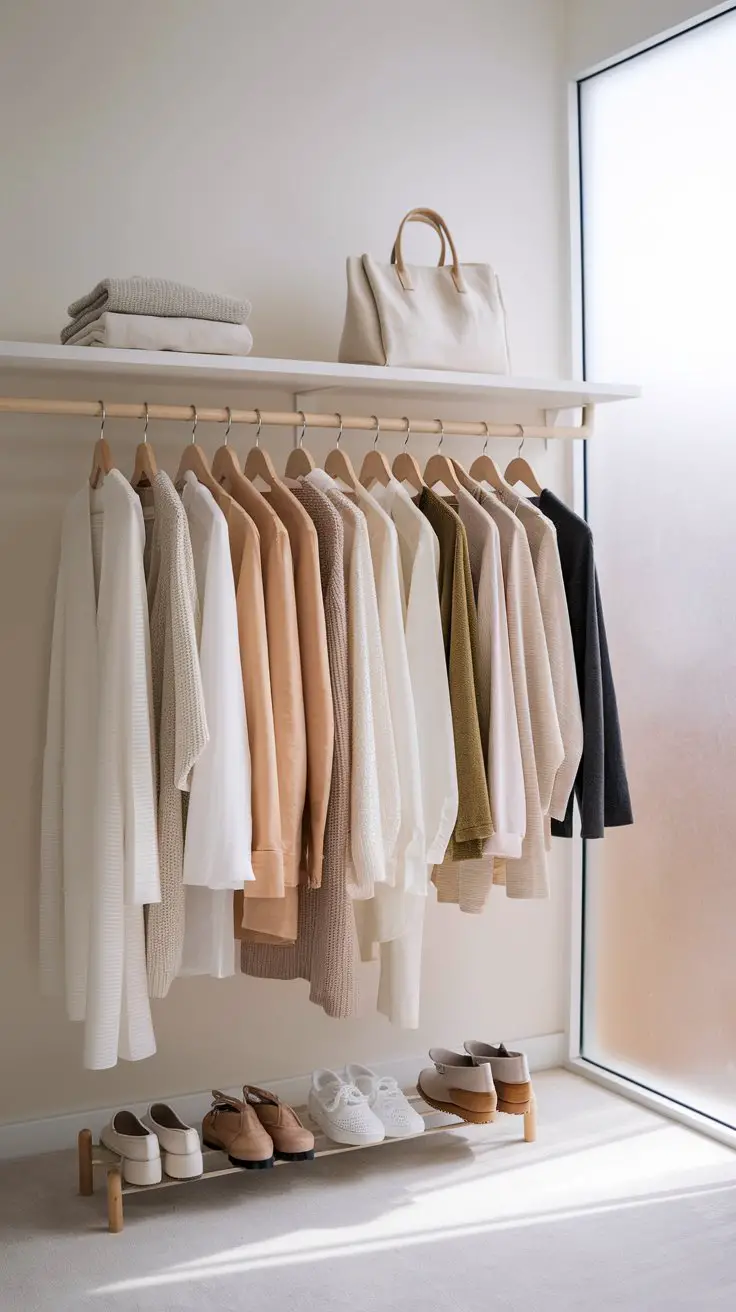
Sometimes the real small closet problem isn’t storage — it’s too many clothes for the space. A capsule wardrobe section within your master walk-in, even if it’s just one designated rod, creates instant visual calm and makes getting dressed infinitely easier.
The idea here isn’t minimalism as a personality type — it’s strategic editing so your most-worn, most-loved pieces are accessible and visible every single day.
How to Recreate This Look
Shopping List:
- Matching slim wood hangers (20–30 pack): $20–$35 on Amazon
- Single dedicated clothing rod (if adding to existing setup): $15–$40 in chrome or matte black
- Small structured bin or basket for seasonal overflow: $15–$30
- Simple wooden shoe rack (5–8 pair): $20–$45 at IKEA or Target
Step-by-Step Styling:
- Choose your capsule items: aim for 20–30 pieces maximum that mix and match freely
- Hang them in one cohesive color arrangement — light to dark, or grouped by category (tops, then bottoms, then layers)
- Switch all to matching hangers — this single change makes any collection look intentional
- Keep your capsule rod visually separate from seasonal or less-worn items — even just a small gap signals the distinction
- Review the section every three months — remove anything you haven’t reached for and move it to the back or donate it
Budget Breakdown:
- Under $100: New matching hangers + one basket + reorganization of existing items — $40–$65
- $100–$500: Full rod system rebuild + shoe rack + bins — $120–$200
Difficulty Level: Beginner — this is more about editing than installing
Seasonal Adaptability: Swap your capsule seasonally — bring your warm-weather neutrals forward in spring and let the knits move back. The bones of the system stay the same; only the contents rotate.
Common Mistake: Keeping things in your capsule zone “just in case.” The capsule only works when every piece earns its spot.
Your Closet, Your Rules
Here’s what I want you to take away from all of this: a small walk-in closet isn’t a design problem — it’s a design opportunity.
The constraint forces you to be thoughtful about what you own, how you store it, and what actually serves you every single morning.
You don’t need to tackle all ten of these ideas at once. Pick the one that solves your most immediate frustration — whether that’s the shoe avalanche, the lighting that makes everything look brown, or the accessories that live in a permanent tangle — and start there.
One good change creates momentum, and momentum creates the kind of closet that makes you feel, just a little bit, like you have your life together. Even when you definitely don’t. <3
The most beautifully organized closet is the one you can actually maintain. Build systems that work for how you genuinely live — messy weekday mornings, lazy Sunday laundry piles, and all.
Your home should work for you, not the other way around. Now go see what that closet can become.

Greetings, I’m Alex – an expert in the art of naming teams, groups or brands, and businesses. With years of experience as a consultant for some of the most recognized companies out there, I want to pass on my knowledge and share tips that will help you craft an unforgettable name for your project through TeamGroupNames.Com!