
You know that moment when your child stares at a simple addition problem like it’s written in ancient hieroglyphics? Yeah. We’ve all been there.
The truth is, most kids don’t hate math — they just haven’t found the version of it that makes their eyes light up yet.
Mental arithmetic sounds serious and school-ish, but it doesn’t have to feel that way at home.
When numbers show up inside games, giggles, and a little friendly competition, something clicks.
Your LO stops thinking “this is math” and starts thinking “this is fun” — and that’s exactly the magic we’re going for.
Whether you’re a SAHM squeezing in some learning between lunch and nap time, a teacher looking for fresh classroom ideas, or just a parent who wants their kid to feel confident with numbers, these 10 games are for you.
No fancy equipment, no advanced degrees in education theory required. Just simple, playful, genuinely effective ways to help young minds get sharper at mental math — one laugh at a time.
Fair warning: some of these games will get competitive. Siblings will argue. Someone will probably accuse someone else of cheating during Number War. That’s just part of the fun. 🙂
1. Number War — The Card Game That Gets Surprisingly Intense

I discovered Number War through another parent at a playgroup, and honestly, I now keep a deck of cards in my bag for waiting rooms and rainy afternoons. It’s that good.
How to Set This Up
- Materials needed: 1 standard deck of playing cards (remove face cards for younger kids, keep them for older ones as bonus challenges)
- Age appropriateness: Basic version ages 4–6; addition version ages 6–10
- Setup time: 2 minutes | Play time: 15–30 minutes | Cleanup time: 30 seconds
- Mess level: 🟢 Low — basically zero mess
- Cost: Free if you already own a deck, or under ₹100/a dollar or two to grab one
How to play:
- Shuffle and deal cards equally between players
- Each player flips over two cards simultaneously
- Players race to shout the sum of their two cards first
- Whoever calls the correct answer first wins all four cards
- The player with the most cards at the end wins
Developmental benefits:
- Rapid mental addition practice
- Builds number sense and quick recall
- Encourages friendly competitive thinking
- Strengthens focus and reaction time
Variations by age:
- Ages 4–5: Flip one card at a time, simply identify the higher number
- Ages 6–8: Add two cards together; first to shout the answer wins
- Ages 8–10: Multiply the two cards — now you’ve got a seriously snappy times table drill
Parent tip: Let younger kids use their fingers at first. The speed will come naturally as they play more. BTW, this game gets extremely loud in households with multiple kids, and that’s a sign it’s working.
2. Snack Math — Learning That Literally Tastes Good

Need an activity that requires absolutely zero setup and zero extra supplies? Snack Math is your new best friend. The premise is almost embarrassingly simple: use whatever snack your child is already eating to do math together.
How to Set This Up
- Materials needed: Any snack — grapes, raisins, crackers, cereal pieces, small fruit chunks
- Age appropriateness: Ages 3–7 (scales beautifully with development)
- Setup time: 0 minutes | Play time: 5–10 minutes | Cleanup time: Your child takes care of cleanup by eating it 😄
- Mess level: 🟢 Low — it’s snack time anyway
- Cost: Free — you’re already feeding them
How to play:
- Arrange snack pieces into small groups on the plate or table
- Ask questions: “If you have 4 grapes and I give you 3 more, how many do you have?”
- Let them count, solve, and — most importantly — eat the answer
- Increase complexity as their confidence grows
Developmental benefits:
- Connects abstract numbers to tangible, motivating objects
- Builds one-to-one correspondence (a cornerstone of early numeracy)
- Introduces addition, subtraction, and even simple fractions (“Can you split these 6 crackers in half?”)
- Positive association with math — eating is always a reward
Variations:
- Subtraction: “You have 8 raisins. You eat 3. How many left?”
- Division intro for ages 6+: “Share these 10 grapes equally between you and your stuffed animal”
- Multiplication for older kids: “Make 3 groups of 4 crackers — how many total?”
Safety note: Always use age-appropriate snack sizes. Avoid round, hard items (like whole grapes) for children under 4 without cutting them first.
3. Dice Rolling Dash — Fast, Loud, and Brilliantly Simple

Rolling dice and shouting answers might be the most underrated math activity in existence. It’s fast, requires almost nothing, and works for a surprisingly wide age range depending on how you scale it.
How to Set This Up
- Materials needed: 2–4 standard dice (foam dice work wonderfully for younger kids), a whiteboard or paper for score-keeping
- Age appropriateness: Ages 4–5 (count the dots); Ages 6–8 (add the numbers); Ages 8–10 (multiply)
- Setup time: 1 minute | Play time: 10–20 minutes | Cleanup time: 1 minute
- Mess level: 🟢 Low
- Cost: ₹50–₹200 / $1–$5 for dice sets; many families already have them in board games
How to play:
- Each player takes a turn rolling two dice
- They must mentally calculate the answer (sum, difference, or product depending on age)
- First to call the correct answer gets a point
- Play to 10 points or set a timer for 10 minutes
Developmental benefits:
- Builds rapid mental recall of number facts
- Introduces probability concepts naturally (“I keep rolling low numbers!”)
- Fine motor practice in handling and rolling dice
- Score-keeping builds number writing and basic tallying skills
Variations:
- Three dice for extra challenge: Add or multiply all three numbers
- Subtraction version: Roll two dice, subtract the smaller from the larger
- Target number game: Set a target (say, 10) and roll to see who can make equations that equal exactly 10
FYI: Foam dice are worth every penny with younger kids — they’re quieter, softer, and don’t roll under the couch 47 times per game.
4. Math Hopscotch — Take the Learning Outside
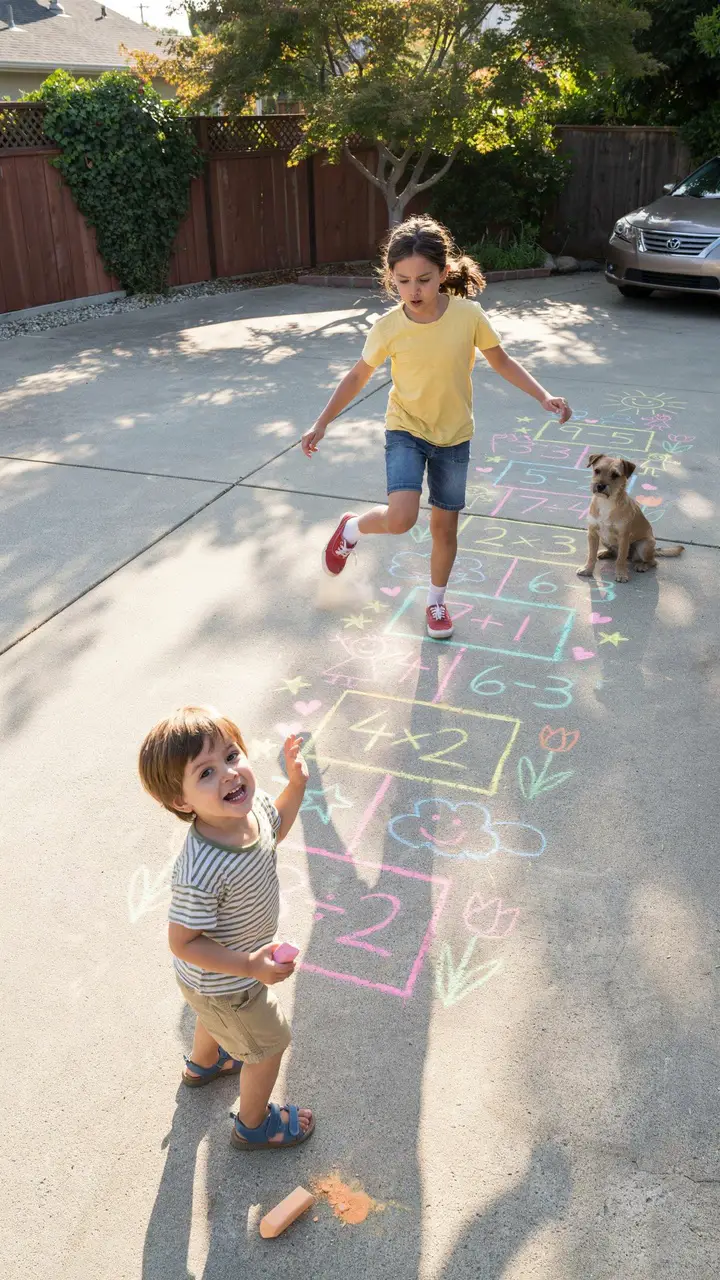
Got a kid who cannot sit still for more than 30 seconds? (Same.) Math Hopscotch turns their endless energy into a mental arithmetic workout. This is one of those activities where you’ll catch yourself thinking, why didn’t I think of this sooner?
How to Set This Up
- Materials needed: Sidewalk chalk, a driveway or paved outdoor area, a small stone or beanbag
- Age appropriateness: Ages 4–9 (adjust equation complexity by age)
- Setup time: 5–10 minutes | Play time: 20–40 minutes | Cleanup time: Rain handles it, or 2 minutes with water
- Mess level: 🟢 Low (chalk washes off easily)
- Cost: Under ₹100 / $2 for chalk
How to set it up:
- Draw a traditional hopscotch grid (9–10 squares)
- Instead of writing numbers 1–10, write simple math equations in each square
- Examples: “2+3,” “8–4,” “3×2,” “10÷2”
- Players hop through, calling out the answer as they land on each square
Developmental benefits:
- Gross motor development combined with cognitive exercise (a powerful learning combination)
- Practices a range of operations depending on equations used
- Outdoor air and movement improve focus and mood for learning
- Self-paced — children naturally slow down on harder problems
Variations by age:
- Ages 4–5: Write the answers in the squares; the child hops to the answer you call out
- Ages 5–7: Write addition equations; hop and shout the sum
- Ages 7–9: Use multiplication or mixed operations in each square
- Rainy day version: Use masking tape on a hallway floor indoors
Parent tip: Let your child write the equations — even if some of them are wildly wrong at first. The ownership makes them so much more invested in playing.
5. The 100-Second Mental Math Sprint
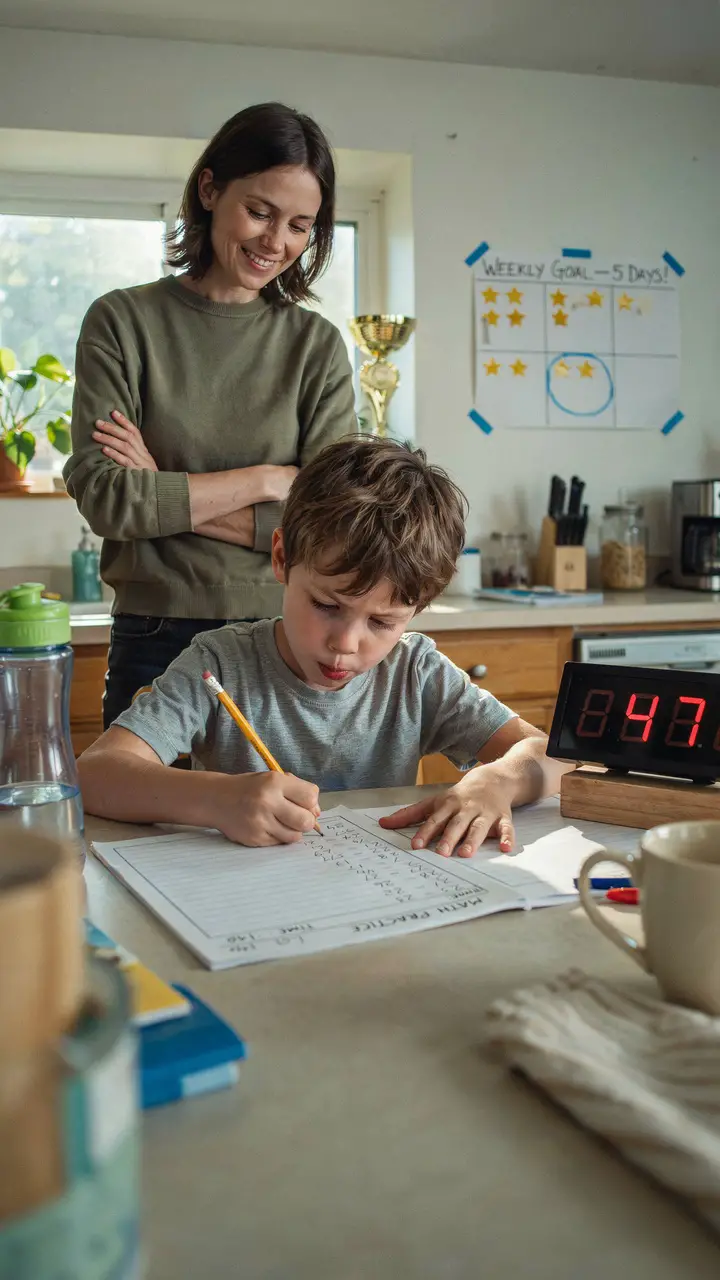
Sometimes a simple timed challenge is exactly what a child needs to discover how capable they actually are. The 100-Second Sprint builds fluency through repetition, but the countdown timer turns it into a game rather than homework.
How to Set This Up
- Materials needed: A timer (phone works perfectly), pencil, paper or whiteboard, and a list of 20–30 math problems suited to your child’s level
- Age appropriateness: Ages 5–6 (counting/addition to 10); Ages 6–8 (addition/subtraction to 20); Ages 8–10 (times tables and mixed operations)
- Setup time: 3–5 minutes | Play time: 2–3 minutes (100 seconds!) | Cleanup time: 1 minute
- Mess level: 🟢 Zero mess
- Cost: Free
How to play:
- Write or print a list of 20–30 problems appropriate for your child’s level
- Set a timer for 100 seconds
- Your child completes as many as possible before the timer beeps
- Record their score and challenge them to beat it tomorrow
Developmental benefits:
- Builds automaticity in number facts — the foundation of confident mental arithmetic
- Short time frame keeps anxiety low and engagement high
- Daily repetition creates measurable, visible progress (kids LOVE seeing their scores improve)
- Builds persistence and a healthy growth mindset around challenge
Variations:
- Create a personal “best score” chart on the fridge — kids are incredibly motivated by their own progress
- Alternate between operations: Monday is addition, Tuesday is subtraction, Wednesday is multiplication
- Make it collaborative: parents do the sprint too — sometimes losing to your kid is the best gift you can give them
IMO, this is one of the highest-impact, lowest-effort math activities out there. Five minutes a day produces genuinely noticeable results within a few weeks.
6. Grocery Store Math — Real Life Is the Best Classroom

Here’s a secret: your weekly grocery run is already one of the best math classrooms on the planet. You just have to narrate it out loud.
How to Set This Up
- Materials needed: Your regular grocery list, a calculator on your phone (as a checking tool for older kids), and a child beside you
- Age appropriateness: Ages 4–5 (counting items); Ages 5–7 (adding prices); Ages 7–10 (budgeting, estimating, making change)
- Setup time: 0 extra minutes | Play time: Your regular shopping trip
- Mess level: 🟢 None
- Cost: You’re already shopping
How to involve them:
- Ask your child to count items as they go into the cart
- Challenge them to estimate: “If apples cost ₹50 and we need 3 bags, how much will we spend?”
- At the checkout, ask them to predict the total before you see it
- Hand older children a small budget (say, ₹100) for choosing a snack — let them work out what they can afford
Developmental benefits:
- Connects arithmetic to real-world purpose — one of the most powerful learning motivators
- Builds estimation skills, rounding, and practical number sense
- Introduces concepts like budgeting, comparison, and value
- Strengthens confidence by making them feel genuinely useful and capable
Parent wisdom: The first time my friend’s 7-year-old correctly estimated their grocery total within ₹20, he was so proud he told his teacher. Real-world math hits differently.
7. Math Story Time — Sneak Numbers Into Bedtime

You’re already reading to them at bedtime. What if a few of those stories were quietly doing math work at the same time?
How to Set This Up
- Materials needed: Math-themed picture books OR any storybook you already own
- Age appropriateness: Ages 2–8 depending on book choice
- Setup time: 0 minutes | Play time: 15–20 minutes | Cleanup time: 0 minutes
- Mess level: 🟢 None
- Cost: Free from your local library
Recommended approaches:
- Choose books with natural counting or number themes: The Very Hungry Caterpillar, Each Orange Had 8 Slices, How Many Snails?, Anno’s Counting Book
- Pause mid-story: “The caterpillar ate 3 plums and 2 strawberries — how many pieces of fruit is that?”
- For any storybook: count characters, add items in illustrations, subtract who left the scene
- Ask predictive questions: “There are 5 animals. If 2 go home, how many will be left at the party?”
Developmental benefits:
- Combines literacy and numeracy in one calm, connected activity
- Builds listening comprehension alongside mathematical reasoning
- Creates positive emotional associations with numbers at the most relaxed part of the day
- Supports language development while strengthening math vocabulary
Parent tip: You don’t need special math books. Any book with objects to count works perfectly. Last week, a parent I know used a dinosaur adventure book to practice subtraction. Creative problem-solving is parenting in a nutshell.
8. Beat the Calculator — Where Kids Discover Their Own Superpower

Nothing — and I mean nothing — motivates a child to practice mental arithmetic like the chance to be faster than a machine. Beat the Calculator is the game that makes kids realize their brain is genuinely powerful.
How to Set This Up
- Materials needed: A basic calculator (phone calculator works), a list of math problems, and a competitive child (usually not hard to find)
- Age appropriateness: Ages 6–10
- Setup time: 2 minutes | Play time: 10–15 minutes | Cleanup time: None
- Mess level: 🟢 Zero
- Cost: Free
How to play:
- One person reads a math problem aloud
- The child solves it mentally while the parent uses the calculator
- If the child answers correctly before the parent finishes typing, they earn a point
- The parent should occasionally be “genuinely slow” at typing — let your kid win, but not every time
Developmental benefits:
- Builds multiplication and addition fluency through high-motivation repetition
- Develops confidence — children learn to trust their own mental processing
- The “vs. machine” framing makes practice feel like a superpower challenge, not a drill
- Strengthens working memory and concentration under mild time pressure
Honest parent wisdom: Start with very easy problems so your child wins often in the beginning. Confidence comes first; challenge comes after. A child who believes they’re good at math will practice more — and that practice loop is everything.
9. Number Bonds with Building Blocks — Math You Can Touch
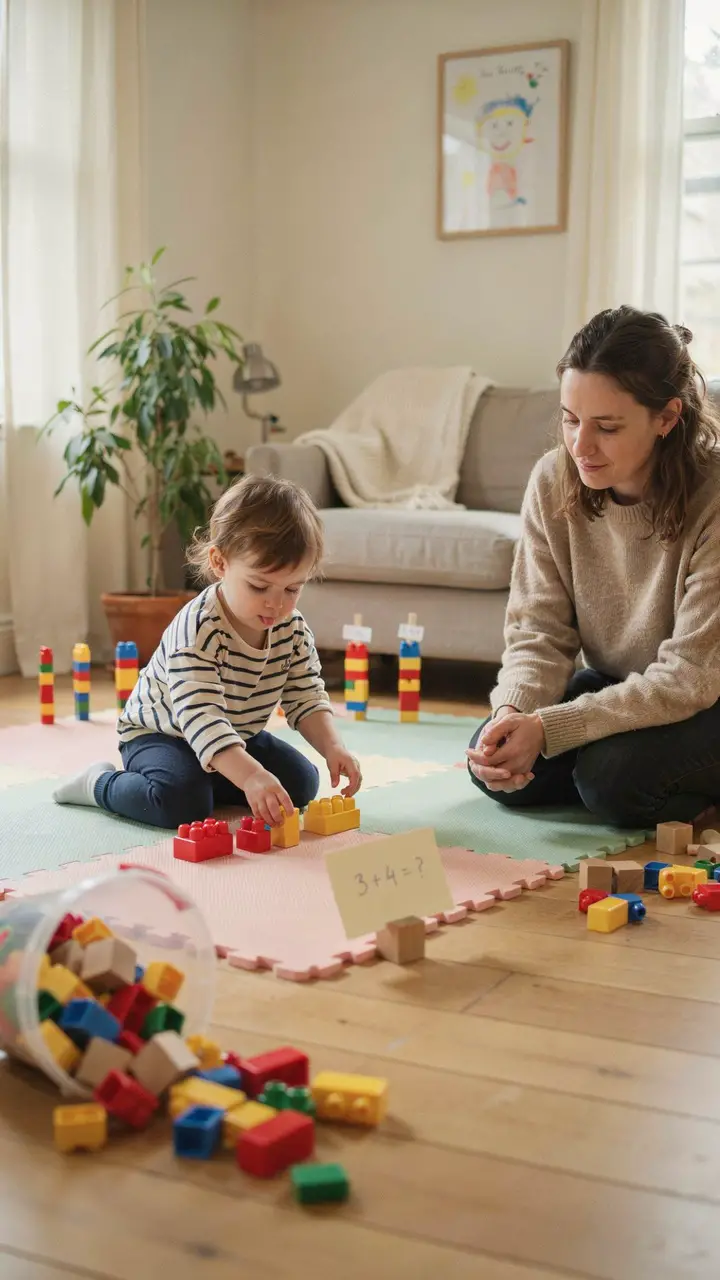
Abstract numbers are hard for young children. Concrete, touchable objects? That’s where early math understanding actually lives.
How to Set This Up
- Materials needed: Building blocks, Duplo/Lego bricks, or even pebbles/buttons from around the house — at least 20 pieces in two different colors
- Age appropriateness: Ages 3–7
- Setup time: 5 minutes | Play time: 15–25 minutes | Cleanup time: 5 minutes
- Mess level: 🟡 Medium — blocks travel across floors with impressive speed
- Cost: Free if you already have blocks
How to play:
- Use two colors of blocks to represent two numbers in a number bond (e.g., 3 red + 4 yellow = 7 total)
- Build towers together and count: “How many blocks are in the whole tower? How many are red? How many are yellow?”
- Remove some blocks and ask what’s missing: “The tower had 7. I took away 4. How many are left?”
- Let the child make their own number bond towers and quiz YOU — they love this reversal
Developmental benefits:
- Provides concrete, kinesthetic representation of abstract addition and subtraction
- Builds part-whole thinking — a foundational concept in early math
- Fine motor skills developed through stacking and sorting
- Color-coding makes number relationships visually memorable
Variations:
- Use blocks of three colors to introduce three-number addition
- Create a “number bond mat” from paper where children place blocks in labeled sections
- Older kids (ages 6–7) can explore the commutative property: “Does 3+4 make the same tower as 4+3?”
10. Family Math Game Night — Old Classics with New Eyes

You probably already own the best math games ever made. You just haven’t thought of them as math games.
How to Set This Up
- Materials needed: Board games you already own — Monopoly, Snakes & Ladders, Uno, Yahtzee, even Scrabble (for score-keeping math)
- Age appropriateness: Varies by game — most are suitable ages 4–10 with minor adjustments
- Setup time: 5 minutes | Play time: 30–60 minutes | Cleanup time: 5–10 minutes
- Mess level: 🟢 Low
- Cost: Free — using what you already have
Why these are math gold:
- Snakes & Ladders / Ludo: Counting, number recognition, addition of dice values
- Monopoly: Addition, subtraction, making change, budgeting — a full financial literacy lesson in disguise
- Uno: Number sequencing, quick recognition, strategic thinking
- Yahtzee: Addition, multiplication, probability — genuinely sophisticated math concepts wrapped in pure fun
- Scrabble / Bananagrams with scoring: Addition practice every single turn
Developmental benefits:
- Builds all four operations through natural, motivated gameplay
- Develops strategic thinking alongside numerical fluency
- Social-emotional skills: taking turns, handling winning and losing gracefully
- Creates positive family memories around numbers — the foundation of a lifelong healthy relationship with math
Parent truth: On the evenings when my household does a proper game night — phones away, popcorn out, everyone at the table — my kids practice more mental arithmetic in one hour than they do in a week of worksheets. And nobody cries. (Usually.)
Bringing It All Together
Here’s the most important thing I can tell you about building strong mental arithmetic skills in your child: consistency beats intensity every time. Ten minutes of Number War on a Wednesday afternoon does more than a two-hour “math session” once a month.
The games above work because they remove the stakes and replace them with joy. When your child is laughing, competing, building, or snacking, their brain is open, relaxed, and genuinely receptive to learning. That’s when the number facts sneak in and stick.
You don’t need a formal curriculum. You don’t need a perfectly scheduled learning plan. You just need a deck of cards on the coffee table, some chalk in the garden, and the willingness to ask “how many?” at snack time.
Your child’s mathematical confidence is built in these small, silly, ordinary moments. The card games and grocery store conversations and bedtime book pauses — these are the memories they’ll carry forward, and the skills that will serve them for life.
Trust the process. Trust your kid. And trust yourself — because the fact that you’re reading a 1,500-word article about math games for your children means you’re already doing something wonderful. <3

Greetings, I’m Alex – an expert in the art of naming teams, groups or brands, and businesses. With years of experience as a consultant for some of the most recognized companies out there, I want to pass on my knowledge and share tips that will help you craft an unforgettable name for your project through TeamGroupNames.Com!